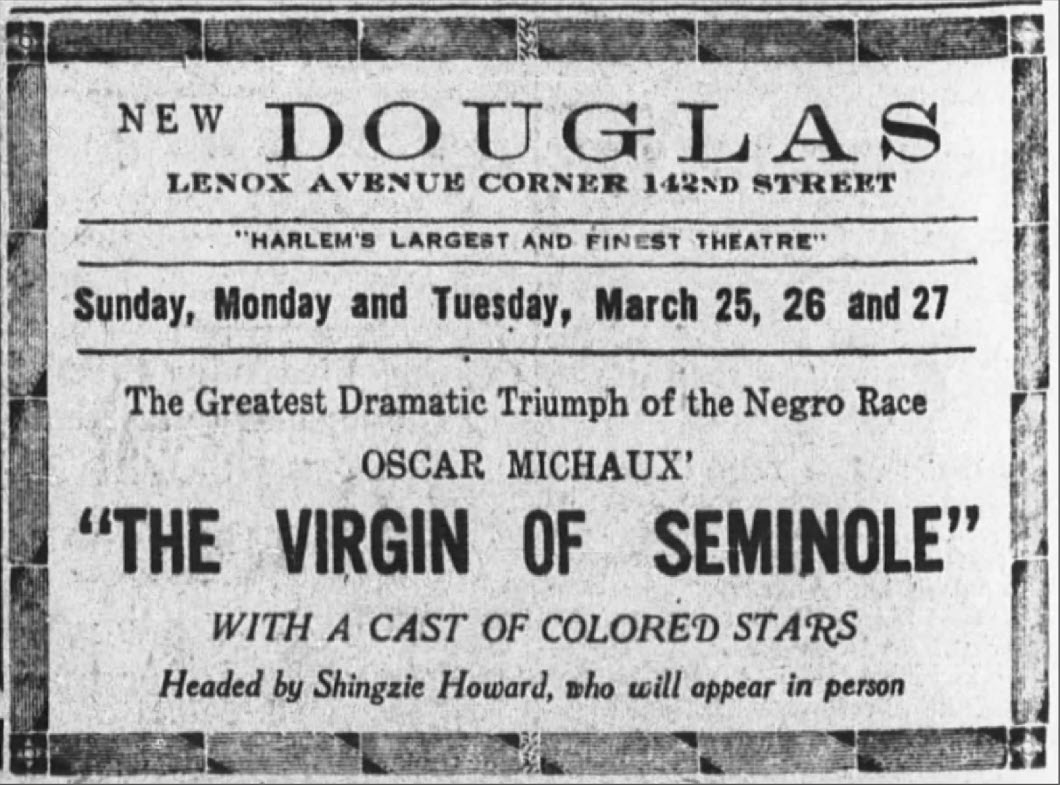
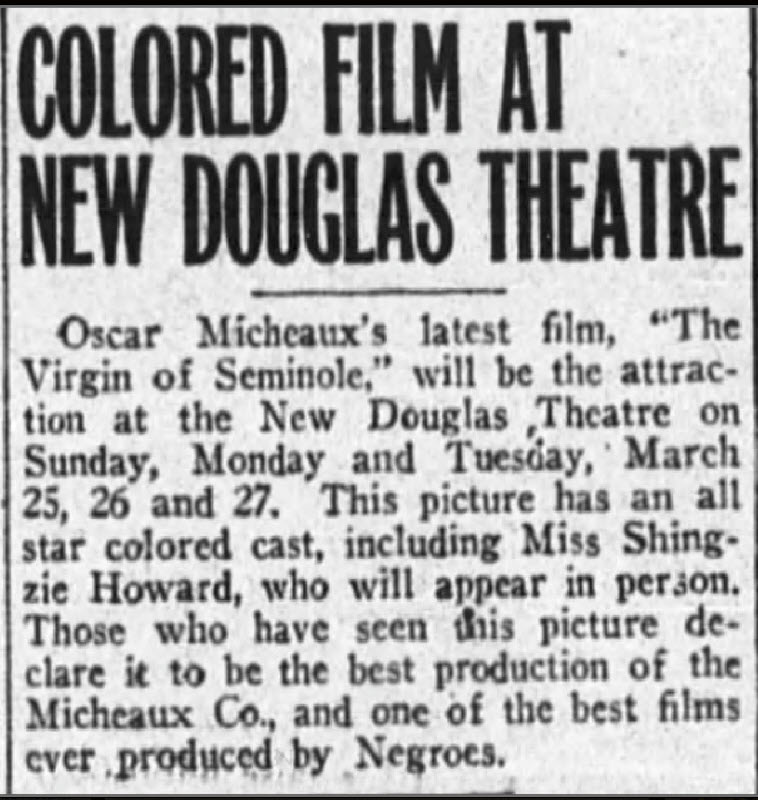
The Virgin of Seminole

Release Date:  12/5/1922
Genre:  Drama
Rating:  NR
Director:  Oscar Micheaux
Studio(s):   Micheaux Film Corp.
B&W
Silent
Cast:  Louise Borden, William Fountaine, Shingzie Howard

Story:  A young Black man from the South enters the Canadian wilds. By virtue of his strength and daring he is made a member of the Canadian mounted police. Through his admirable work as an officer, and especially through his gunfight with a desperado, the young man becomes rich and famous, then purchases a ranch and finds true love.

Another source explains the pot as an adventure that follows the efforts of a Black Canadian Mounted Policeman to rescue a woman from Native Americans.  He receives a reward and the love of the woman.

The film had its premiere in Chicago in December 1922 and was distributed by the Micheaux Film Corporation. No print is known to exist, and it is considered to be a lost film.  Sources:  tcm.com, Reel Black Talk: A Sourcebook of 50 American Filmmakers by Spencer Moon.  Photos:  daaracarchive.org.

Regeneration

Release Date:  12/25/1923
Genre:  Action/Drama
Rating:  NR
Director:  Richard E. Norman
Studio(s):  Norman Film Mfg. Co.
B&W
Silent

Cast:  Stella Mayo (Violet Daniels), M.C. Maxwell (Jack Roper), Alfred Norcom, Charlie Gaines, R.L. Brown, Clarence Rucker, Steve Reynolds.

Story:  After a widowed sea captain dies he leaves his only daughter, Violet Daniels, a map detailing the location of buried treasure on an unknown south seas island.  Violet and Jack Roper leave on his fishing schooner, the “Anna Bell,” to find the treasure. During the voyage the ship’s mate, Knife Hurley, attempts to steal the map and there is a fight involving the crew he has recruited from the scum of the waterfront. The ship is set on fire, and Knife escapes in the only lifeboat with the map and his crew. Violet and Jack are left to die on the burning boat, however, they survive on a raft they build and after days of drifting, hungry and thirsty, they arrive at an uninhabited island. They name the island Regeneration and begin life anew. Sometime later, Knife and his crew land on Regeneration, which turns out to be the island on which the treasure is buried.  Eventually Knife is defeated.

Notes:  Contemporary information about the exact conclusion of the film has not been located. The movie was a hit, not just with black audiences but with white patrons, too, as a benefit from director and founder of Norman Studios, Richard E. Norman’s unique promotional methods. In particular, Norman encouraged theaters to fill their lobbies with sand to draw potential customers in. Unfortunately, no known full copies of Regeneration exist. However, Kino Lorber restored an 11-minute portion of the second reel, archived in the Library of Congress, though video remains largely obscured by nitrate decomposition.  Sources:  tcm.com, daaracarchive.org.  Photos:  imdb.com.

Preview Clip

The House Behind The Cedars

Release Date:  12/6/1924
Genre:  Drama
Director:  Oscar Micheaux
Studio(s):  Micheaux Film Corp.
Running Time:  Unknown
Silent
Black & White

Cast:  Shingzie Howard (Rena Walden), Andrew Bishop (George Tryon), Lawrence Chenault (John Walden), Alma Sewell, William Crowell, Douglas Griffin, Oliver Hill.

Story:  Rena, a beautiful, mixed-race woman who “passes” as white, receives a proposal from an aristocratic white millionaire who has fallen in love with her. Rena accepts without revealing the secret of her racial background. Unhappy, she returns to her former lover, Frank Fowler, a black man who has risen to power “despite his color”.  She tells him that although she has fooled the public, she has not fooled herself.

Details:  The House Behind the Cedars, was adapted by Oscar Micheaux from the novel of the same name by Charles Chestnutt, published by installments in the Chicago Defender. Although the film was based on Chestnutt’s novel, Micheaux capitalized on a timely news story by adding a top line to the billing which read, “The Rhinelander Case.” This referred to the 1925 Rhinelander v. Rhinelander trial, which involved a light-skinned, mixed-race woman named Alice Jones, who had married a wealthy white man named Kip Rhinelander. Rhinelander attempted to annul their marriage after his disapproving parents threatened to disinherit him; Micheaux took advantage of the similarities between the news story and his film to boost ticket sales, as noted in the December 2, 1925 issue of Variety, which announced that a new short film called The Rhinelander Case was soon to be released by the Bejack Film Co.

This film is considered lost.

Source:  AFI Catalog (catalog.afi.com).