Details: Year of Release: 1919 Genre: Drama Rating: N/A Runtime: Unknown
Silent
Black & White Studio: Micheaux Book and Film Company Producer: Oscar Micheaux Director: Oscar Micheaux; Jerry Mills
Cast:
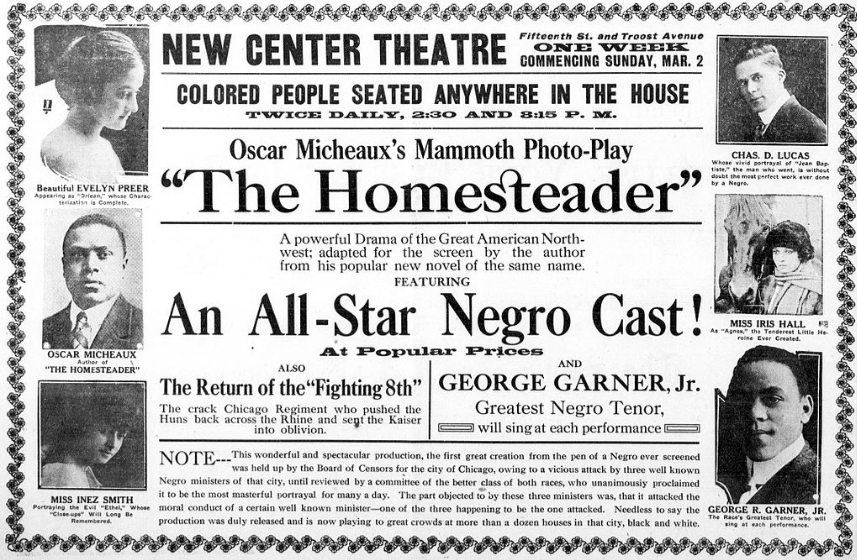
Charles D. Lucas (Jean Baptiste) Evelyn Preer (Orlean)
Iris Hall (Agnes Stewart)
Vernon S. Duncan (McCarthy)
Inez Smith (Ethel)
Trevy Woods (Glavis/Ethel’s husband)
Synopsis: In South Dakota, Agnes Stewart, a Scottish girl takes refuge in an isolated house during a blizzard. Hearing cries outside, she rescues Jean Baptiste, a Black homesteader who was in danger of freezing to death. Baptiste falls in love with Agnes, who does not know that she is not White. Baptiste despairs of overcoming the social barriers that prevent their union He returns east and marries Orlean, the daughter of McCarthy, a vain and greedy minister. Baptiste is persecuted by McCarthy and by Ethel (McCarthy’s other daughter), who, like her father, possesses “all the evil a woman is capable of.” When Orlean goes insane and commits suicide, Baptiste returns to South Dakota, finds Agnes and discovers that she is really Black. The two are able to be together and find happiness at last.
Notes:
Oscar Micheaux’s first film.
Some information in the plot synopsis comes from a 1927 interview with Evelyn Preer.
Micheaux’s 1948 film The Betrayal is sometimes described as a loose remake of TheHomesteader.
Source(s): TCM; Wikipedia; Photo: By Micheaux Book & Film Company via Wikimedia Commons.
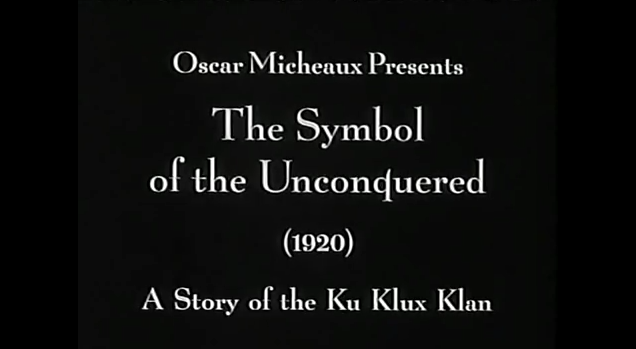
a/k/a The Symbol of the Unconquered: A Story of the Ku Klux Klan a/k/a The Wilderness Trail
Details Year of Release: 1920 Genre: Drama Rating: N/A Runtime: 54 mins. (TCM print)
Black & White
Silent Studio: Micheaux Film Corporation Producer: Oscar Micheaux Director: Oscar Micheaux
Cast
Iris Hall (Eve Mason)
Walker Thompson (Hugh Van Allen)
Lawrence Chenault (Jefferson Driscoll)
Mattie Wilkes (Mother Driscoll)
Louis Déan (August Barr)
Leigh Whipper (Tugi an Indian Fakir)
E.G. Tatum (Abraham)
George Catlin (Dick Mason)
Jim Burris
James Burrough
Synopsis
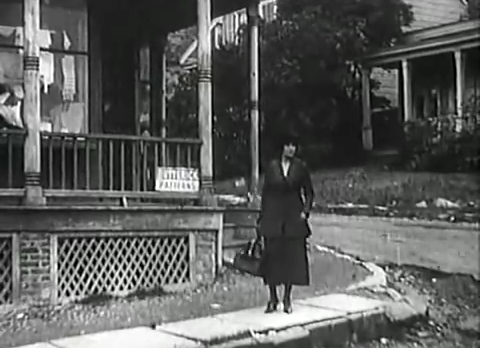
Eve Mason, a light-skinned Black woman, leaves Selma, Alabama for the northwest town of Oristown to claim the land and small house she inherited upon the death of her grandfather. A fatigued Eve arrives at the Driscoll Hotel, which is owned by Jefferson Driscoll, another very light-skinned Black who wants to pass for White. Driscoll hates the Negro race because his darker skinned mother once interfered with his wooing a White woman. In spite of her light skin, Driscoll realizes Eve is Black as “her eyes betray her origins” and refuses to give her a room, instead he leads her to the barn where he has allowed Abraham, another potential guest who Driscoll refused to rent a room to because of the color of his skin. During the night Eve is frightened by Abraham and flees the barn into the pouring rain. The next day she meets kindly Hugh Van Allen, a young, Black prospector who has recently arrived in Oristown.
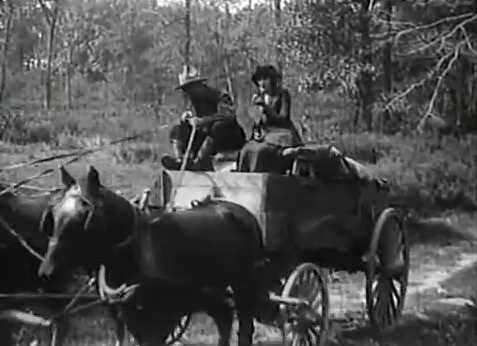
It turns out Van Allen is her neighbor and he offers Eve a lift to her place outside of town. A White couple, Mary and August Barr, are also neighbors of Van Allen and Eve. August Barr is a former clergyman turned swindler and “a man of dubious financial schemes.” Barr is in cahoots with his brother-in-law and an Indian fakir named Tugi to get back documents stolen by “half-breed Indian,” Philip Clark and which were then taken by an old Black prospector, believed to be Dick Mason, Eve’s grandfather. The three determine that the documents are in Mason’s old cabin, where Eve is now living.
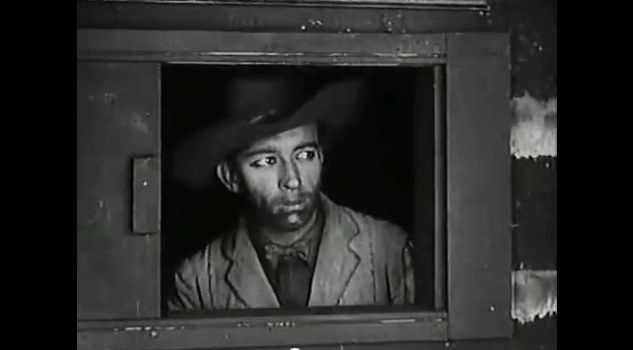
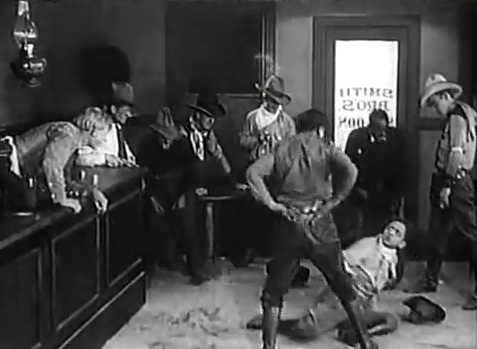
That night Eve sees a terrible face looking in on her and cries out in fear. Van Allen hears her and rushes to the rescue, but the intruder has gone. Meanwhile Driscoll has sold his hotel and gets involved with horse thieves, Philip Clark and old Bill Stanton. When he tries to pass off two stolen nags as thoroughbreds to Van Allen, the two get into a fight at the local bar and Van Allen beats up Driscoll to the amusement of the bar patrons. Humiliated, Driscoll vows revenge.
Eve with Van Allen’s assistance, works hard to make the most of her modest homestead. Mary Barr, August’s unhappy wife, and Eve soon become friends. In town, Driscoll intercepts a letter meant for Van Allen which states that his land sits on an oil field. Driscoll, in league with Barr and Tugi, men plot to get Van Allen’s valuable land. They decide to get old Bill Stanton involved, as he knows how to make people do things they don’t want to do.
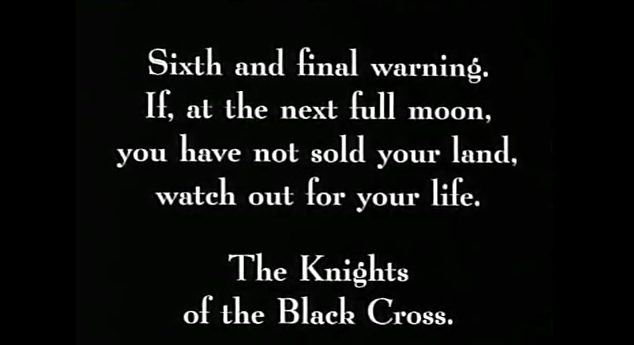
They post notes signed by The Knights of the Black Cross on Van Allen’s tent, threatening his life if he won’t sell his land. Van Allen ignores the notes, leaves for town to buy furniture and won’t be back for 48 hours. In his absence, the last note is posted, giving him 48 hours to sell.
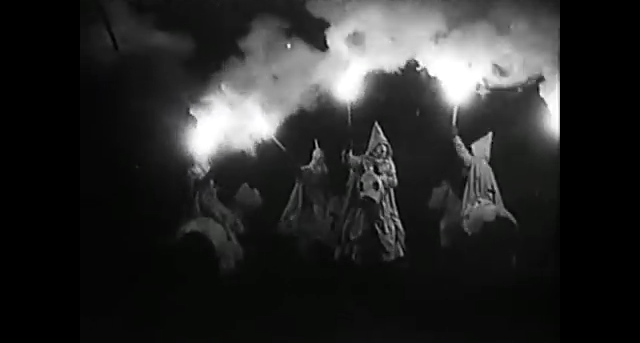
The group, led by Bill Stanton, plan a midnight attack and Stanton tells the others, “in one hour we will have driven him mad and burned him in his lair.” Barr’s wife Mary, upset by the planned massacre, goes to warn Eve, who rides to town for help, just as Van Allen returns, unaware of the impending attack.
At this point footage is missing from the print. Title cards state “the biggest moments of the photoplay are when the night riders are annihilated, a colored man with bricks being a big factor.”
Two years pass and Van Allen, having escaped death by a miracle, has become an oil king as his land was found to contain abundant oil fields. One day Eve appears at his office to deliver a letter from the Committee for the Defense of the Colored Race, informing Van Allen that he “may give Eve his contribution without fear as she has rendered a great service to the cause of the Black race; despite her white skin, she is born of black parents”. Bewildered, Van Allen had always believed that Eve was White and had never declared his love for fear of being scornfully rejected.
He becomes emotional and Eve, misinterpreting his mood, believes she has now fallen in his esteem.
Eventually they resolve the misunderstanding and live happily ever after.
Notes
Opening title card states: The Symbol of the Unconquered has been restored by the Museum of Modern Art – Department of Film and Video and Turner Classic Movies in cooperation with The Oscar Micheaux Society.
Micheaux’s fourth feature length film and one of his earliest surviving works.
Shot in Fort Lee, NJ under the working title The Wilderness Trail.
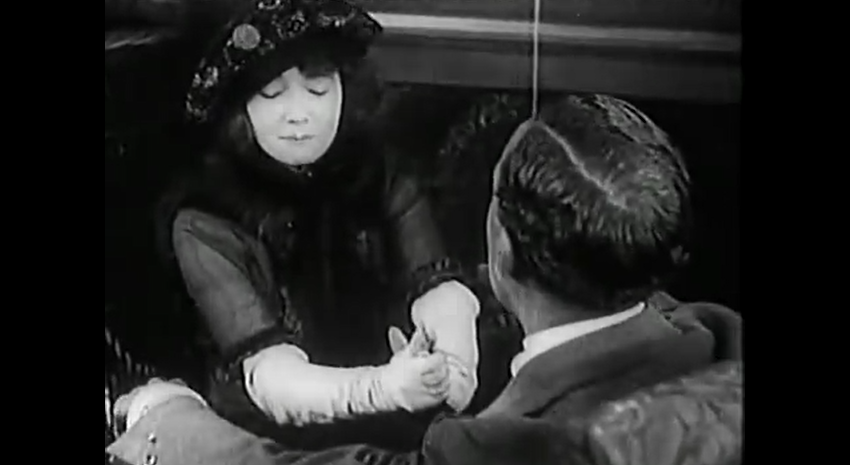
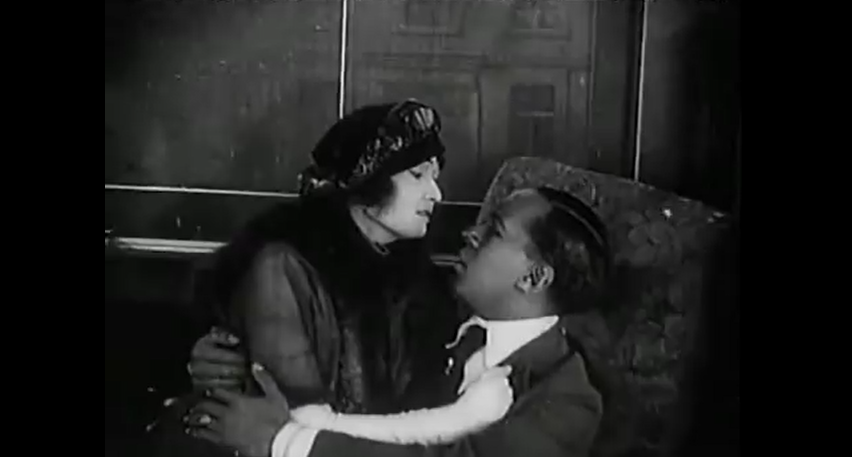
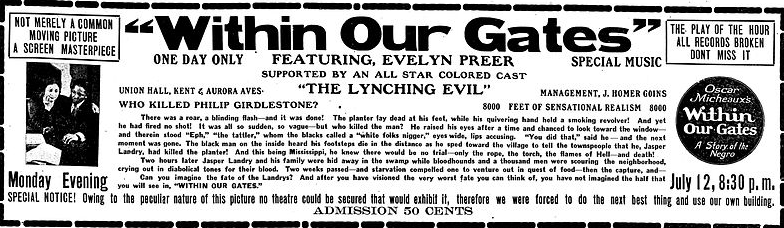
DETAILS Year of Release: 1920 Genre: Drama Rating: N/A Runtime: 79 mins. Black & White Silent Studio: Micheaux Film Co. Producer: Oscar Micheaux Director: Oscar Micheaux
CAST Evelyn Preer (Sylvia Landry)
Flo Clements (Alma Prichard)
James D. Ruffin (Conrad Drebert)
Jack Chenault (Larry Prichard)
William Smith (Philip Gentry, a detective)
Charles D. Lucas (Dr. V. Vivian)
Bernice Ladd (Mrs. Geraldine Stratton)
William Starks (Jasper Landry)
Ralph Johnson (Philip Griddlestone)
E. G. Tatum (Efrem)
Grant Edwards (Emil)
SYNOPSIS
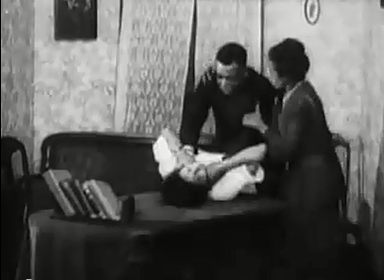
Sylvia Landry, a young black woman from the South, visits her Northern cousin, divorcee Alma Prichard. Sylvia’s fiancé, Conrad Drebert, writes to her from Brazil, where he is working, to tell her that he will send a telegram with the date of his arrival. When the telegram arrives, Alma, who is in love with Conrad, intercepts and destroys it. When Conrad arrives, Alma sets up Sylvia to be seen with another man.
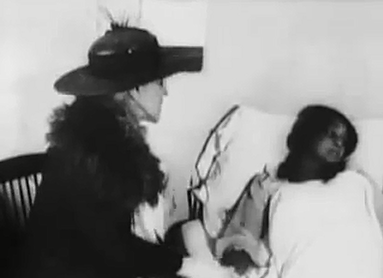
Enraged, Conrad tries to strangle her, but she is saved by Alma. Conrad storms out and breaks their engagement, much to Alma’s satisfaction. Saddened by the breakup, Sylvia leaves town and takes a job at a school for poor black children in the southern town of Piney Woods, that is run by Reverend Wilson Jacobs and his sister Constance. When money troubles hit the establishment, however, Sylvia decides to go to Boston to find a rich benefactor. One day, depressed that she has not met any rich people to take an interest in the school’s plight, Sylvia saves a little boy from being struck by the car of rich philanthropist Elena Warwick, and is herself injured. Mrs. Warwick visits her in the hospital and Sylvia tells her that the school must find $5,000 in the next ten days or it will close.
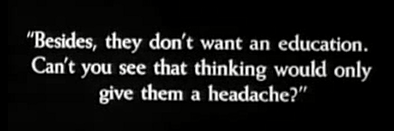
Mrs. Warwick is set to give the school the money until she speaks with her friend, Mrs. Geraldine Stratton, who convinces the naïve Mrs. Warwick that educating blacks is a mistake, and that they are more suited to being field hands and lumberjacks. She suggests giving the money to Old Ned, a black preacher whose fiery sermons encourage blacks to remain “pure” and untainted by education, culture and politics.
When Sylvia returns to collect the school’s money from Mrs. Warwick, she is refused, but later, Mrs. Warwick changes her mind and sends the school fifty-thousand dollars.thousand dollars. Sylvia returns to Piney Woods, where Jacobs proposes. Sylvia refuses the offer, however, as she has fallen in love with Doctor V. Vivian, a young Boston man deeply committed to improving blacks’ social conditions.
Meanwhile, Larry, Alma’s stepbrother, a notorious gangster, flees police after killing another gambler in a card game. He escapes to Piney Woods and plans to swindle the poor blacks in the region by selling them stolen goods. Larry eventually encounters Sylvia, with whom he was once in love, and tells her that he will reveal her past to the school’s administrators if she does not steal the school’s money for him.
Distraught, Sylvia returns to Boston. Larry, meanwhile, has also gone back North and is shot while trying to rob a bank. When Dr. Vivian goes to the Prichards’ to tend Larry’s wounds, he meets Alma, who tells him about Sylvia’s past.
Flashback: Sylvia was adopted by the Landrys, a family of poor black southerners. When she was a young girl, the Landrys sent Sylvia to school, and the educated girl eventually discovered that her father’s landlord and employer, Philip Griddlestone, owed him $625.00. Armed with his daughter’s calculations, Mr. Landry goes to see Griddlestone, who rudely dismisses him. At that moment, a white laborer whom Griddlestone had earlier swindled, enters the room and shoots Griddlestone. Efrem, Griddlestone’s gossipy, meddlesome servant, screams through the town’s streets that Mr. Landry murdered his employer. A lynch mob is formed and the Landrys run away, taking refuge in the swamps. The manhunt continues for a week, and, frustrated that the Landrys had eluded them, the mob attacks and kills the traitorous Efrem, who had been gloating about how much the whites loved him. Mr. and Mrs. Landry and their young son Emil are captured. The parents are hanged and burned at the stake, but Emil escapes. Meanwhile, the real killer is accidentally shot by the mob. Griddlestone’s brother, Armand, follows Sylvia back to the home of her parents’ friends. Armand attacks Sylvia and tries to rape her, but sees a scar on her breast and suddenly realizes that Sylvia is his own daughter from his union with a black woman. Armand then pays for the girl’s education but never tells Sylvia that he is her father.
In the present, Dr. Vivian finds a distraught Sylvia and tells her that they must remember that their people fought in Cuba, Mexico and France for the freedom of their great country. Confident that once married Sylvia will be an excellent wife and a confirmed patriot, Dr. Vivian is not disappointed.
NOTES
Within Our Gates was Oscar Micheaux’s earliest surviving directorial effort.
Within Our Gates stirred up considerable controversy during its original release because it contained scenes of lynching and racial conflict. At first the film, which eventually had its premiere in Chicago, was rejected by the Chicago Board of Movie Censors who were afraid the movie could possibly inspire a race riot. However, a second screening of the film by the press, Chicago politicians, and prominent members of the Black community convinced the Censors to grant the film a permit since it addressed horrendous conditions that needed reform. Not everyone agreed with this assessment, however, and some of the most vigorous protesters against the film were black activists. By June 1920, the film was edited down, with much of its controversial material removed.
Films featuring Black performers and images have evolved from those which reflected the notions of Whites to those which fully explore African-American issues and themes. Early movies created during the beginning of the 20th century typically portrayed African-Americans in insulting stereotypes or utilized Whites in blackface instead of Black actors. Blackface involved White actors covering their faces with black make-up and drawing on exaggerated lips to complete the parody. This technique originated in the minstrel shows of the mid-19th century in which African-Americans were portrayed as stupid, lazy, clownish, superstitious, and frivolous. These shows degraded the African-American community and made fun of Blacks by making them look foolish, utilizing stereotypical characters such as Coons, Mammies, Sambos, and Uncle Toms. Such stereotyping and disparaging representations were used to disassociate Blacks and Whites, an established practice in America since the days of slavery.
With the invention of moving pictures, the minstrel tradition of demeaning Blacks for the entertainment of White audiences carried over into the new medium. Black characters were rarely presented in film and when they were they were typically portrayed as the same stereotypical caricatures, never as serious or fully developed individuals.
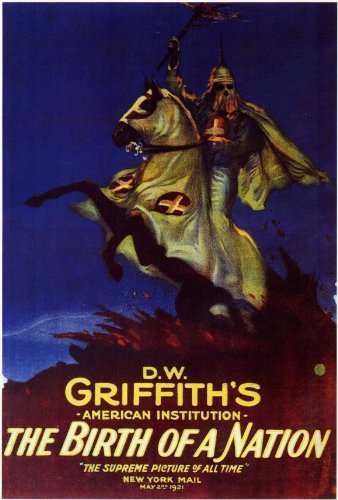
One such movie, was The Birth of A Nation, a 1915 silent film directed by David Wark “D. W.” Griffith. By 1915 Griffith was an established director who developed a repertoire of techniques including crosscutting, intercutting, expressive lighting, camera movement, and the close-up. He grew up hearing stories of the Old South’s power and grandeur and in 1914 began working on his film masterpiece which would later be praised for its technical innovations, epic narrative and imagination, drawing huge crowds around the country and becoming Hollywood’s first true blockbuster. An adaptation of Thomas Dixon’s novel “The Clansman: An Historical Romance of the Ku Klux Klan” BOAN chronicled the rising racial, economic, political and geographic tensions leading up to and through the Civil War, emancipation, Abraham Lincoln’s assassination and the tumultuous southern reconstruction period in American History.
In spite of its innovation as a movie megahit, it was condemned as racist by leaders in the African-American community as well as by White liberals. This film took racial stereotypes to a whole new level. It showed blacks as inferior, maniacal, unintelligent, and brutal, raping and disrespecting good White folk, and generally running amok. The film’s Confederate hero’s response to these insufferable injustices by the newly freed and unruly slaves, was to start the Ku Klux Klan, a righteous organization, portrayed as saviors of the South, who ride in at the end and save the Whites from the savage Negroes.
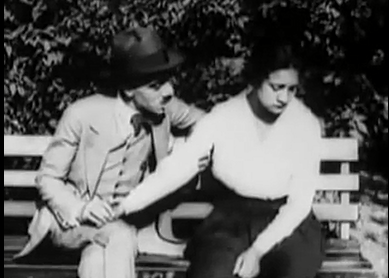
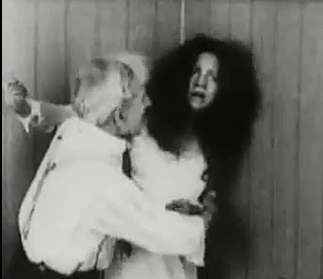
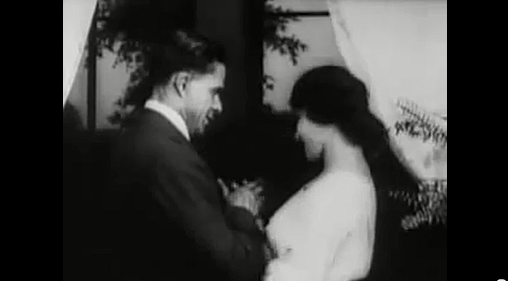
White actor in Blackface.After the war, “illiterate” Black gain control of the legislatureFlora runs in fright and jumps off a cliff to her death rather than be raped by a Black man.
After Flora’s death the Black soldier, Gus, is captured and hanged by the Klan
Upon its release, BOAN sparked national protest, drawing the ire of the newly formed NAACP and was the catalyst for riots in several major cities in which it was screened. Even at this early stage in motion picture history, African-Americans saw the potential of film as a set of images and messages that could influence the opinions and behavior of a large number of people as well as the way in which the experiences of African-Americans could be distorted and exaggerated. Yet, despite its racist, exploitative message, its historical inaccuracy, and its’ rejection by entire regions of the country, the 190-minute silent epic was the most profitable film in history for a number of years and well into the “talkie” film era. BOAN gave birth to the lurid and degrading stereotypes that were to endure in African-American movie images for years to come.In an effort to counterbalance such negative portrayals, African-American entrepreneurs ventured into filmmaking. In addition, a handful of independent “Colored” film companies were emerging. These companies were owned by Whites but catered to film audiences in the nearly 400 Black movie theaters, most of which were in the South. But a major problem in producing these films was financing.
One Black producer who was able to get his films made with a minimum of capital, was one-time homesteader, novelist, salesman and overall wheeler-dealer, Oscar Micheaux who, in 1918 formed The Micheaux Film and Book Company. Another early Black cinema pioneer was Noble Johnson, the Hollywood character actor who, along with his brother George, established The Lincoln Motion Picture Company in Los Angeles in 1916. But actor, writer and vaudeville agent, William Foster (also known as July Jones), is widely considered the first African-American to establish a Black film production company to feature films with all African-American casts, when in 1910 he founded The Foster Photoplay Company out of Chicago. The companies established by these innovators were at the forefront in producing “Race Films,” movies that featured all-Black or predominantly Black casts and were marketed to African-American audiences.
Lincoln Picture’s, The Realization of a Negro’s Ambition (1916) and Micheaux’s, The Homesteader (1919), were among the first feature films to present themes in concert with the effort by African-Americans to combat the negative portrayal of their community. Ideologies of racial advancement were based on the predication that Blacks were human beings as well as Americans deserving of equality and social justice. These beliefs emphasized education and morality and were actualized in films through plots that emphasized temperance, religion and social advancement through education.
During the 1920s through the mid-1930’s there was an abundance of Black-owned film studios operating throughout the U.S. Although the films were produced on limited budgets, the popularity of race movies gave birth to a counter cinema with its own stars, a highly organized and tightly run distribution system, and a multitude of exhibition venues including Black owned movie houses like the Howard Theater in Washington, D.C., and the Madame C. J. Walker Theater in Indianapolis. In addition to such theaters, the films were also shown at Black churches and schools, segregated theaters or at midnight and matinee showings in White theaters.
Unfortunately many of the Black independent film companies did not survive the Great Depression nor the invention of expensive sound technology. In the 1930’s and 40’s few of the films made for Black audiences were made by Blacks. Many of the production companies were now owned by White businessmen with White technicians behind the cameras. These companies included the Norman Film Manufacturing Company, Ebony Pictures and The Colored Players Film Corporation. One of the few exceptions was Micheaux, who maintained control of his production company, long after many Black owned companies went bankrupt and disappeared. In spite of this, there were still a multitude of Black producers, directors, screenwriters, actors and actresses who worked on films which were not meant for mainstream movie audiences and as such they had influence on how African-American life was portrayed. During the early period of Race films, the movies focused on themes relative to the Black community such as passing, lynching, religion and criminal behavior. Eventually, the focus of the films changed and plots combined Race and Hollywood styles in which gangster movies, westerns, horrors and musicals portrayed Black concerns.
Race films, both those produced by Black companies as well as White, continued to remain popular with Black audiences through the mid-50s, as they provided stories which reflected experiences that movie goers could relate to and portrayed characters that contradicted White America’s notions of the place of African-Americans in society. It is estimated that more than 500 race movies were produced and distributed between 1910 and 1948, although fewer than 100 of these exist today due to the use of highly flammable and delicate nitrate film stock and the failure to utilize proper storage methods which led to the loss of many early films.
The significance of these productions to contemporary audiences lies in the fact that they provide a glimpse of how Blacks saw themselves and their world during the era in which they were made. They should not be condemned for their lack of artistic value, due to limited budgets and production quality, but appreciated for their reflections of Black culture by highlighting African-American vernacular, dance, music, fashion, and glamour. It can be said that without the early Black independent film movement, there would be few Black themed films today.
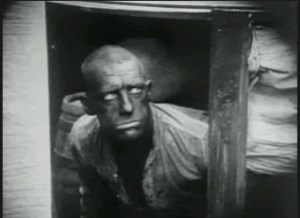
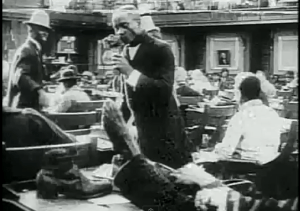
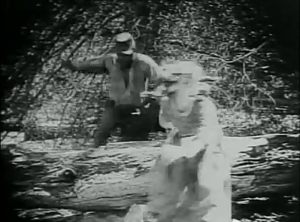
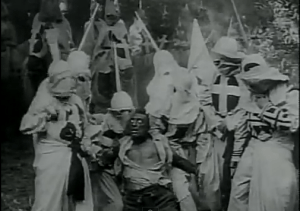


 Race films, both those produced by Black companies as well as White, continued to remain popular with Black audiences through the mid-50s, as they provided stories which reflected experiences that movie goers could relate to and portrayed characters that contradicted White America’s notions of the place of African-Americans in society. It is estimated that more than 500 race movies were produced and distributed between 1910 and 1948, although fewer than 100 of these exist today due to the use of highly flammable and delicate nitrate film stock and the failure to utilize proper storage methods which led to the loss of many early films.
 Black Cinema Connection