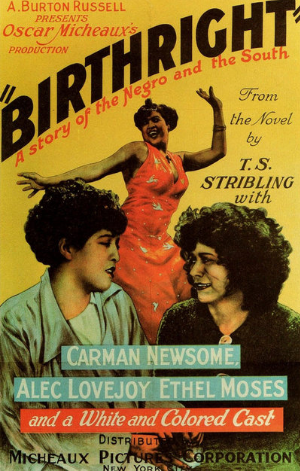
BIRTHRIGHT

Birthright (1939)

Tagline
A Story Of The Negro And The South

Details
Year of Release:   1938
Genre:   Drama
Rating:  N/A
Black & White
Studio:  Micheaux Pictures Corporation
Director:  Oscar Micheaux

Cast

Carman Newsome, Laura Bowman, S. O. Moses, Alec Lovejoy, Trixie Smith, Hazel Lisz, W. Herbert Jelly, Ida Forsyne, John Ward, C. R. Chace, Alice B. Russell, H. E. Knight, George Vessey, Columbus Jackson, Harry Moses, Tom Dillon, Allen Lee, Robert Alderdice.

Synopsis

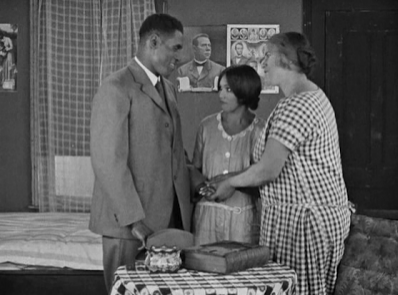
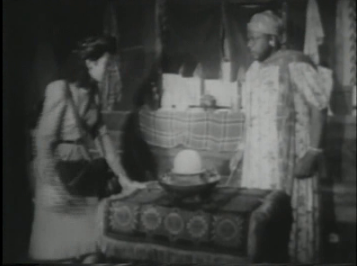
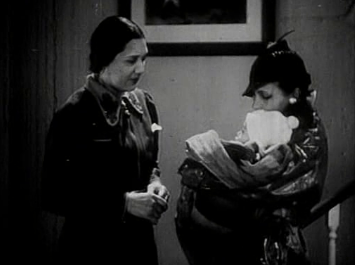
Harvard University graduate Peter Siner is trying to raise money to start a school for blacks. On his way to Hookers Bend, his hometown in the South, Peter encounters his friend Tump Pack, a decorated war hero and a gambler.  Soon Peter attracts the attention of every eligible girl in town, including Cissie Dildane. Although Cissie pledges a contribution to fund Peter’s school, she tells him that she disagrees with his approach to bettering the condition of blacks through industrial training, and instead favors literacy education.

Peter purchases an old building from the unscrupulous white banker Henry Hooker, but eventually learns that Hooker has been scheming against him and trying to thwart his efforts to establish a black school in the area. When Peter takes a closer look at the contract he signed, he realizes that it contains a “stopper clause” preventing blacks from having anything to do with the property. He complains to Hooker, who offers to buy back the deed at a fraction of the original purchase price.

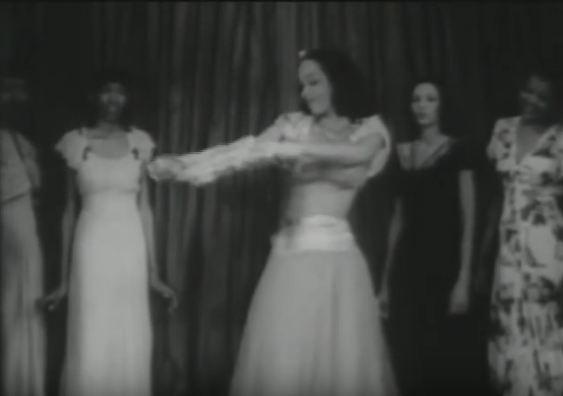
Following the death of his mother, Peter goes to work for the town’s richest man, Captain Renfrew.  Renfrew’s maid resents having to serve Peter as if he were a white man and lies to Renfrew, by telling him that Peter plans to marry Cissie, who, she claims, is a suspected thief. The sheriff arrests Cissie, however, she escapes and goes to a nightclub, where her sister, Ida May is performing.  When Peter arrives at the nightclub, he gets a telegram stating that Renfrew has died and left everything to him, including 90% ownership in the bank where Hooker works. He also reads that charges against Cissie have been dropped.

Peter develops plans to turn Renfrew’s mansion into an industrial training school.   After successfully establishing his school, he marries Cissie, and the couple drive to Chicago for their honeymoon.

Notes

From the novel by T. S. Stribling.

Oscar Micheaux made an earlier film based on the same source in 1924.

The first two of the film’s nine reels have been missing for years. To replace about 20 minutes of the missing scenes, restorers have added new title cards to introduce the story of Peter Siner.

Source(s): 

TCM; Poster Source:  NPR.org.

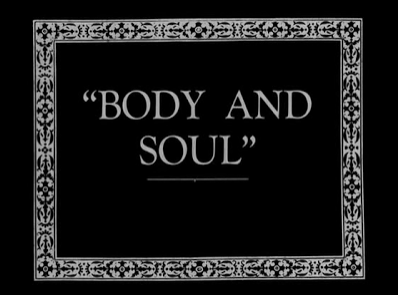
BODY AND SOUL

Body and Soul still #1Details
Year of Release:  1925
Genre:   Drama
Rating:  N/A
Runtime:  102 mins.
Black & White
Silent
Studio:  Micheaux Pictures Corporation
Director:  Oscar Micheaux

Cast

Paul Robeson (Reverend Isaiah Jenkins/his brother Sylvester)
Julia Theresa Russell (Isabelle)
Mercedes Gilbert (Sister Martha Jane)
Lawrence Chenault (Yellow-Curley Hinds)
Chester A. Alexander (Deacon Simpkins)
Walter Conick (Brother Amos)
Lillian Johnson (Sis Ca’line)
Madame Robinson (Sis Lucy)

Synopsis

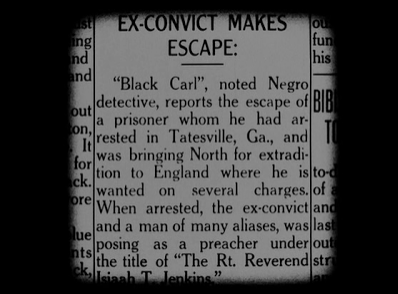
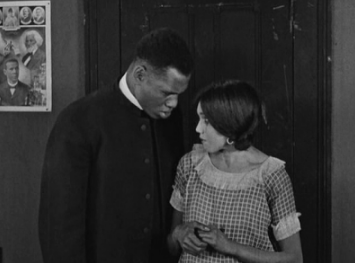
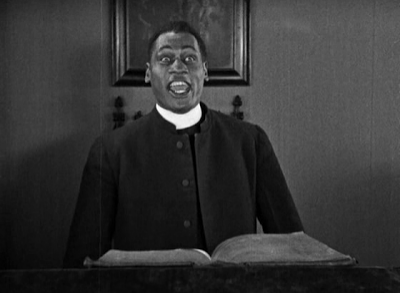
Body and Soul still #2In Tatesville, Georgia, a prisoner being transported North for extradition to Britain, escapes and takes on the disguise of Reverend Isaiah Jenkins. With his fiery sermons, Pastor Jenkins gains many followers in the small town, including, Sister Martha Jane, the hard-working mother of a young daughter named Isabelle. Jenkins falls in love with Isabelle, even though she is in love with a poor young man named Sylvester, who happens to be Jenkins’ estranged twin brother.

Jenkins is joined in Tatesville by Yellow-Curley Hinds, another criminal whom he knew in jail, and together they plan to swindle Jenkins’ congregation by selling liquor at inflated prices and taking the parish’s contributions. Martha Jane has been saving her hard-earned money, which she hides in a Bible, so that Isabelle and Pastor Jenkins can marry and buy a house. When Isabelle learns of her mother’s plans, she is horrified and calls Jenkins a drunk and a sinner.  Body and Soul still #14Angry at her daughter, Martha Jane leaves Isabelle alone in the house with Jenkins, so that he can save her soul. Jenkins steals Martha Jane’s money, convinces Isabelle to take the blame and flee to Atlanta, as her mother would never believe that her dear pastor was the culprit.

After Martha Jane finds her daughter’s written confession, she forgives her and goes to Atlanta where she finds Isabelle ill and living in poverty.  Before dying, Isabelle tells her mother that Jenkins took advantage of her and that he is the one who took the money.  Martha Jane cradles her daughter in her arms, and shortly thereafter, Isabelle dies.

Body and Soul still #11Returning to Tatesville, Martha Jane goes to the church where a drunken Jenkins is giving his “Dry Bones in the Valley” sermon to the congregation.  Martha Jane publicly accuses Jenkins of being her daughter’s murderer, and the congregation turns on him. That night, Jenkins, hunted by bloodhounds, arrives at Martha Jane’s house and tells her that her pampering ruined him.  When two church ladies arrive, Martha Jane hides Jenkins in the kitchen and sends the women away. Forgiven by his accuser, but unrepentant, Jenkins takes refuge in the woods. When he encounters one of his pursuers, Jenkins brutally kills the man.

Body and Soul still #13The next morning, Martha Jane awakens to realize that the events she thought transpired the night before were actually a dream. Although earlier Martha Jane had refused Sylvester’s proposal for her daughter on the grounds that he was too poor, she now offers to give the couple the money in the Bible so that they can marry right away.

Notes

Best-known silent film of pioneer filmmaker Oscar Micheaux, offered the great singer/actor/athlete, Paul Robeson, his first opportunity in films.   Although it was a theme that proved controversial with his audiences, Micheaux turned several times to the subject of corruption and dishonesty among the clergy.

As part of the agreement to star in the film, Robeson received a $100 per week salary plus three percent of the gross after the first $40,000 in receipts.

Source(s)
TCM; Blaxploitation Pride

EXILE, THE

The ExileDetails
Year of Release:   1931
Genre:  Drama
Rating:  N/A
Runtime:  93 min.
Black & White
Studio:  Micheaux Film Corp.
Director(s):  Leonard Harper & Oscar Micheaux

Cast
Eunice Brooks (Edith Duval)
Stanley Morrell (Jean Baptiste)
Katherine Noisette (Madge)
Charles Moore (Jack Stewart)
Nora Newsome (Agnes)
George Randol (Bill Prescott)
A. B. Comathiere (An outlaw)
Carl Mahon (Jango)

Synopsis

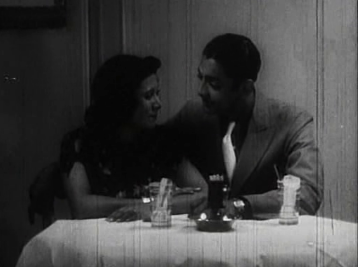
Edith Duval, a former maid, occupies a Southside Chicago mansion after it is abandoned by its wealthy  owner.  She is part of a wild crowd that likes to gamble, dance and have a good time.  One night, when she throws a huge party for her friends, Jean Baptiste, a sincere young man, confesses his love for her.  Edith is delighted and tells Jean her plans to turn the house into a gambling club.  Outraged by the suggestion, Jean declares his desire to take her away to a farm in South Dakota to earn an honest living.  Edith, however, scornfully sends him away.

Five years later, Jean has become a successful farmer.  Meanwhile, Agnes, the daughter of his neighbor, is very attracted to him and, although Jean returns her love, he breaks off the romance because he is afraid that she will have a difficult life if they marry because she is white.

Brokenhearted, Jean returns to Chicago. There, he visits Edith’s nightclub, and determined to put Agnes behind him, proposes to Edith again. This time she happily accepts.  Unfortunately, an old lover of Edith’s shoots her in a jealous rage and Jean is accused of her murder.  Upon seeing his name in the paper, Agnes decides to go to his aid. Her father tells her that her mother was of Ethiopian descent, so it is all right for her to marry Jean. Just as she arrives in Chicago, she meets Jean, who has been completely cleared of the crime. The two set off for a happy married life in South Dakota.

Notes

This film, which was billed as the “first Negro talker,” was Micheaux’s first sound film. The Variety review notes that it “runs” only partly in dialogue, the rest of the film uses sound synchronization.

Modern sources note that after a successful premiere in New York, the first showing in Pittsburgh was halted midway by two members of the Pennsylvania Board of Censors, because, they claimed, it lacked a seal indicating that it had been passed by the Board. There was speculation at the time that the real reason was that certain scenes showed a black man making love to a light-skinned woman.

Modern sources give the following information about the production: that Micheaux thought that his ending, which ultimately skirted the issue of interracial love, would allow the picture to be shown; that a second version of The Exile was made because Micheaux was unhappy with Stanley Morrell’s performance; and that many scenes were reportedly reshot with Lorenzo Tucker in the lead role, and advertisements were printed announcing him in the starring role.  No prints of the Tucker version have been located, and it is possible the film may not have been completed.

Source(s)
TCM; Poster Source:  Wikipedia.

DIRTY GERTIE FROM HARLEM, U.S.A.

Dirty Gertie from Harlem, USADetails
Year of Release:  1946
Genre:  Drama/Romance
Rating:  N/A
Runtime:  60 mins/65 mins.
Black & White
Studio: Sack Amusement Enterprises
Producer:  Alfred N. Sack & Bert Goldberg
Director:  Spencer Williams

Cast
Francine Everett (Gertie LaRue)
Don Wilson (Diamond Joe)
Kathrine Moore (Stella Van Johnson)
Alfred Hawkins (Jonathan Christian)
Boykin (Ezra Crumm)
Piano Frank (Larry)
John King (Al)
Shelly Ross (Big Boy)
Hugh Watson (Tight Pants)
Don Gilbert (Manager)
Spencer Williams (Old Hager)

Synopsis

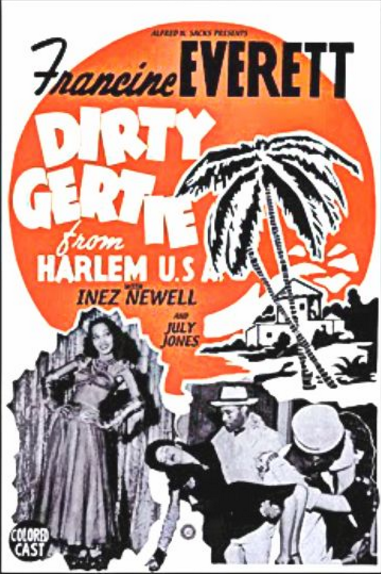
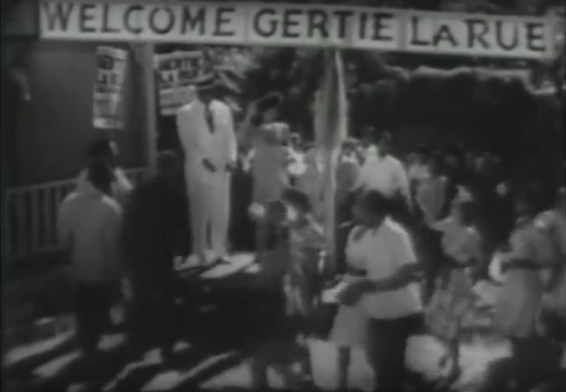
Dirty Gertie From Harlem still #10When famous Harlem dancer Gertie LaRue arrives on the island of Rinidad, she is given celebrity treatment and taken to the Paradise Hotel, where she and her assistant, Stella Van Johnson, are placed in the posh bridal suite.  The hotel’s proprietor, Diamond Joe, is smitten with Gertie, but Gertie ignores Stella’s suggestion that she take an interest in him.  Meanwhile members of Gertie’s troupe discuss Gertie’s past relationship with a generous man named Al, who Gertie treated poorly and deserted.  Gertie has earned the nickname “Dirty Gertie” for the casual nature in which she entices and then humiliates men.

AlsoDirty Gertie From Harlem still #4 staying at the hotel is the pious Mr. Jonathan Christian and his assistant Ezra Crumm, two missionaries who have come to the island to lecture about sin. Having witnessed Gertie’s flirtatious behavior on the boat, Mr. Christian tells Ezra that she is a “painted trollop.”  Gertie remains true to her reputation as a gregarious flirt when she joins a sailor named Tight Pants and a soldier named Big Boy for a drink at the Diamond Palace lounge.  The bar’s piano player recognizes Gertie and plays a tune intended to stir memories of her troubled past in Harlem and her relationship with his friend Al.  When Gertie returns to the hotel drunk and in the company of the two military men, Mr. Christian watches in horror as she kisses both of them.  Gertie faints when Mr. Christian emerges from the shadows.  When she regains consciousness, she misinterprets his actions and accuses him of trying to take advantage of her.

Dirty Gertie From Harlem still #7Later that day, Gertie, having been spooked by bad omens since her arrival on the island, goes to a fortune teller, an old woman named Old Hager.  The old woman looks into her crystal ball and sees Gertie’s misdeeds and has a vision of a man coming after her. However, neither the medium’s predictions nor Mr. Christian’s best efforts to have the Diamond Palace shut down prevent Gertie from taking the stage and performing her striptease.

Dirty Gertie From Harlem still #11During her act, Mr. Christian takes to the stage and orders an end to the show.  A brawl ensues when he grabs Gertie, but Diamond Joe whisks her out of the club and takes her back to the hotel.


Alone in her room, Gertie is unhappy with the image of herself in the mirror. At that moment Al bursts into the room and shoots her.  When Stella and the police rush into the room, Al tells them that he killed her because he loved her.

Dirty Gertie From Harlem still #12Notes

As noted by modern sources, the storyline of the film is loosely based on W. Somerset Maugham’s 1921 short story “Miss Thompson.”  The story was adapted for the stage by John Colton and Clemence Randolph as Rain in 1922, and for motion pictures several times including Miss Sadie Thompson in 1928 starring Gloria Swanson and the 1932 Rain starring Joan Crawford.

Sources

TCM; William Jones:  Black Cinema Treasures Lost and Found; Blaxploitation Pride.

GOD’S STEP CHILDREN

a/k/a ALL GOD’S STEPCHILDREN
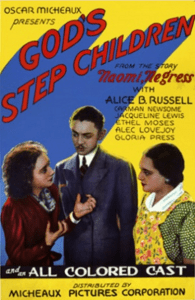
God's Stepchildren

Details
Year of Release:  1938
Genre:  Drama
Rating:  N/A
Runtime:  105 mins.
Black & White
Studio:  Micheaux Pictures Corp.
Director:  Oscar Micheaux

Cast
Jacqueline Lewis (Naomi, as a child)
Ethel Moses (Mrs. Cushinberry/ her daughter Eva)
Alice B. Russell (Mrs. Saunders)
Charles Thompson (Jimmie, as a child)
Carman Newsome (Jimmie, the man)
Gloria Press (Naomi, the woman)
Alec Lovejoy (Ontrue Cowper)
Laura Bowman (Aunt Carrie)

Synopsis
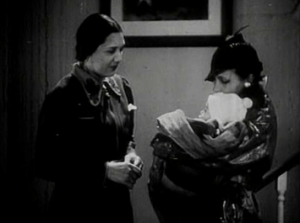
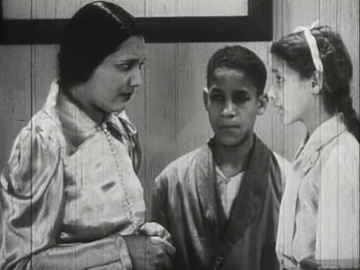
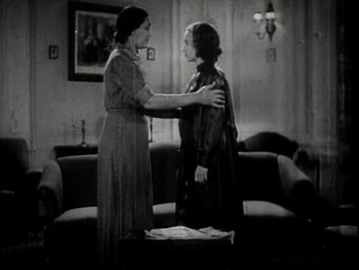
God's Stepchildren still #1A stranger arrives at the home of widow Mrs. Saunders and begs her to adopt her baby daughter, whom she cannot afford to feed. After the stranger leaves, Mrs. Saunders, a black woman, realizes that the child is white, and is advised by her friend to turn it over to the police. In the daylight, however, Mrs. Saunders sees that the child, which she has named “Naomi,” is black, and believes that the girl will make a good playmate for her son Jimmie.

Time passes, and Naomi, now a young schoolgirl, is thought by the other children to be aloof and is accused of not wanting to be black. When Naomi disappears on her way to school one day, Mrs. Saunders is told by Jimmie that Naomi deliberately avoided the black school she was supposed to attend and went to a white school. Naomi denies Jimmie’s accusation and tells her mother that he is lying because he hates girls. When Mrs. Cushinberry threatens to give Naomi a beating for being insolent and mean, Naomi, in an angry outburst, tells the teacher that she hates her and all the other children because they are black. Naomi rejects Mrs. Cushinberry’s insistence that “we’re all God’s children,” and tells her that God “didn’t make Negroes.”
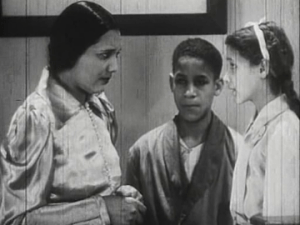
God's Stepchildren still #5That evening, Mrs. Cushinberry pays a visit to Mrs. Saunders to tell her about Naomi’s behavior, but when she realizes that Naomi has not told her mother about what happened, she decides to remain silent. Naomi, however, has been eavesdropping, and when the teacher leaves, she tells her mother that it was the teacher who was bad. Jimmie intervenes, however, and reveals the truth. Mrs. Saunders then gives Naomi a beating. Later, Naomi starts a rumor that Mrs. Cushinberry has been having an affair with a married professor, and a riot ensues at the school. The angry crowd of students march to the school superintendent’s house and demand that he fire both teachers. Mrs. Saunders, who has been told of the riot by Jimmie, rushes to the superintendent’s office to dispel the rumor started by her daughter.

While Naomi is sent to a convent, Jimmie, who has earned money by working as a Pullman porter invests in a farm.  God's Stepchildren still #7 After proposing marriage to his sweetheart Eva, Jimmie invites his mother to live on his new farm.  Naomi, who has been reformed by her life at the convent, apologizes to her mother for being a bad child. Jimmie’s mother arranges to have him take Naomi to the city for entertainment. Though things go well in the city, Eva’s aunt Carrie does not trust Naomi’s unnatural interest in Jimmie and believes that she should be watched.  Aunt Carrie’s suspicions prove to be well-founded as Naomi soon confesses her love for her adopted brother.
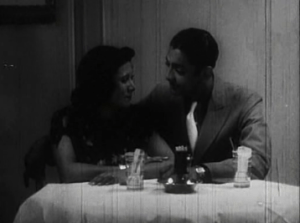
When Jimmie, Eva and Naomi return to the country, Jimmie introduces Naomi to his friend, Clyde Wade, who immediately falls in love with her.  Clyde is dark-skinned with a country accent.  Naomi finds him repulsive and confesses to Jimmie that she has always wanted him to marry her.   Realizing that Eva would be crushed by the loss of Jimmie, Naomi consents to marry Clyde.

One year later, Naomi tells her mother that she is leaving Clyde and her newborn son and that she is also “leaving the Negro race.”  God's Stepchildren still #16
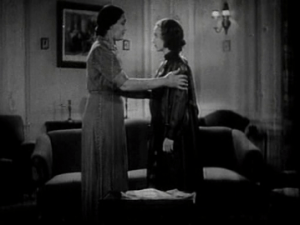
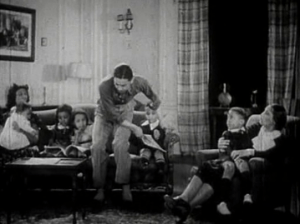
Naomi marries a white man who realizes that she is a mulatto when he notices her reaction to seeing her son and her mother.  Naomi tries to lie about her past, but he sees through it and turns her out.  Naomi goes back to the farm one night and silently creeps up to the window, through which she sees a happy family scene that will never include her.  God's Stepchildren still #15After getting one last look at her family, Naomi drowns herself in the river.
Notes

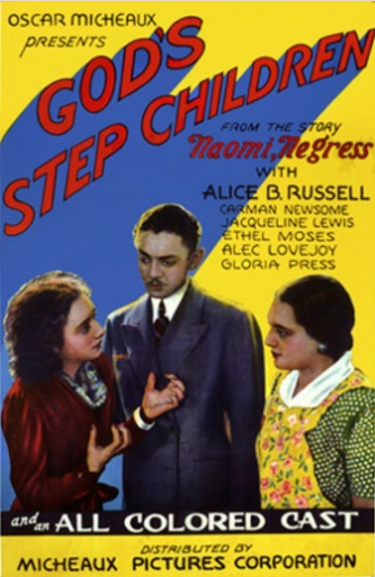
The original version of the film contained footage that was cut soon after its release.  The Exhibitor review refers to this film as All God’s Stepchildren. A trailer for the film contained the following title card: “God’s Step Children, from the story ‘Naomi Negress!’ With an all-star colored cast.”

“Naomi Negress!” May have been an original screen story written by the film’s director and producer, Oscar Micheaux. The cover sheet of the dialogue script contains a “producer’s note,” in which it is written that “all the characters appearing herein, regardless how bright in color they may seem, are all members of the Negro Race.”

According to a May 1938 New York Times article, the film was “withdrawn from circulation” two days after its premiere at the RKO Regent theater in New York. The decision to withdraw the picture was the result of an unfavorable audience reaction to the film and a protest outside the theater. The article quoted Beatrice Godloe, head of the Young Communist Committee, which organized the picket, as saying that the film “slandered Negroes, holding them up to ridicule, playing light-skinned Negroes against their darker brothers.” The film was eventually re-cut and the following scenes were removed from the print: The opening scene between the stranger and Mrs. Saunders in which the dialogue centers on “Naomi’s” skin color; a portion of the scene in which “Naomi’s” teacher says “we’re all God’s children” and Naomi responds “[God] didn’t make the black ones”; a flashback scene in which Mrs. Cushinberry and her alleged paramour profess their love for each other; and a brief sequence at the end showing Naomi with a white husband, who asks her why she has become troubled after having peered into a house with “two Colored people and a boy.”

Actress Alice B. Russell was Micheaux’s wife.

Source(s)
TCM; Blaxploitation Pride
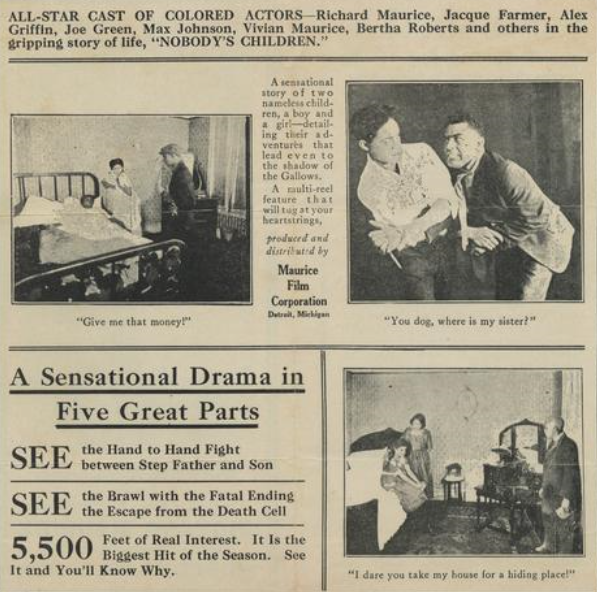
Nobody’s Children

a/k/a OUR CHRISTIANITY
a/k/a OUR CHRISTIANITY AND NOBODY’S CHILD
a/k/a OUR CHRISTIANITY AND NOBODY’S CHILDREN

Nobody's Children article

Details
Year of Release: 1920
Genre:  Drama
Rating:  N/A
Runtime:  Unknown
Black & White
Silent
Studio:  Maurice Film Co.
Producer:  Richard Maurice
Director:  Richard Maurice

Cast
Richard Maurice
Jacques Farmer
Joe Green
Alex Griffin
Max Johnson
Vivian Maurice
Howard Nelson

Synopsis

A brother and sister are persecuted by their evil stepfather, who kidnaps the girl and imprisons her. A fight between the boy and the stepfather leads to the stepfather’s death.  The boy is arrested and sentenced to death for the crime. His cellmate helps him escape, and he is eventually exonerated, pardoned, and reunited with his sister.

Notes
This film is considered lost.

Photo Source: The Digital Library of Georgia/The University of Georgia Libraries. Source(s): TCM, IMDB