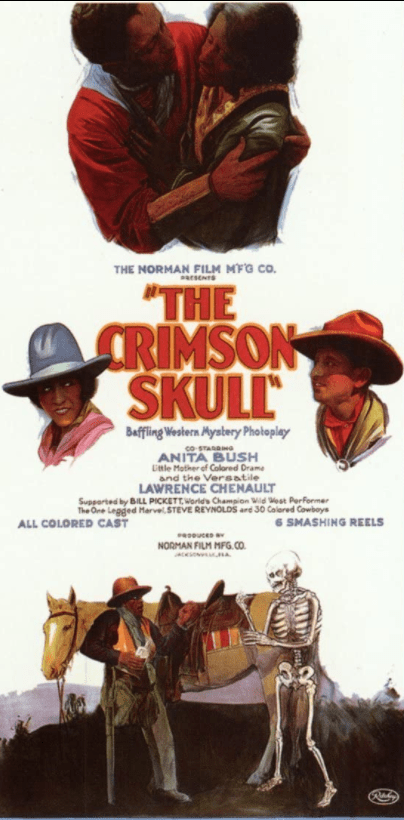
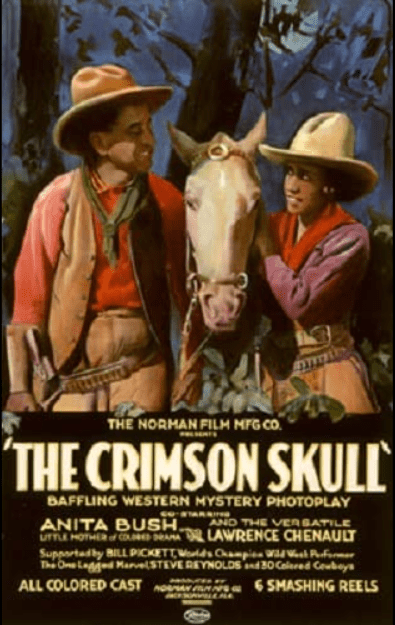
The Crimson Skull

Release Date:  4/20/1922
Genre:  Action
Director:  Richard E. Norman
Studio(s):  Norman Film Manufacturing. Co.
Running Time:  Unknown

Cast:  Anita Bush (Anita Nelson), Lawrence Chenault (Bob Calem), Bill Pickett (Bill), Steve Reynolds (Bob’s Sidekick, billed as The One-Legged Marvel).

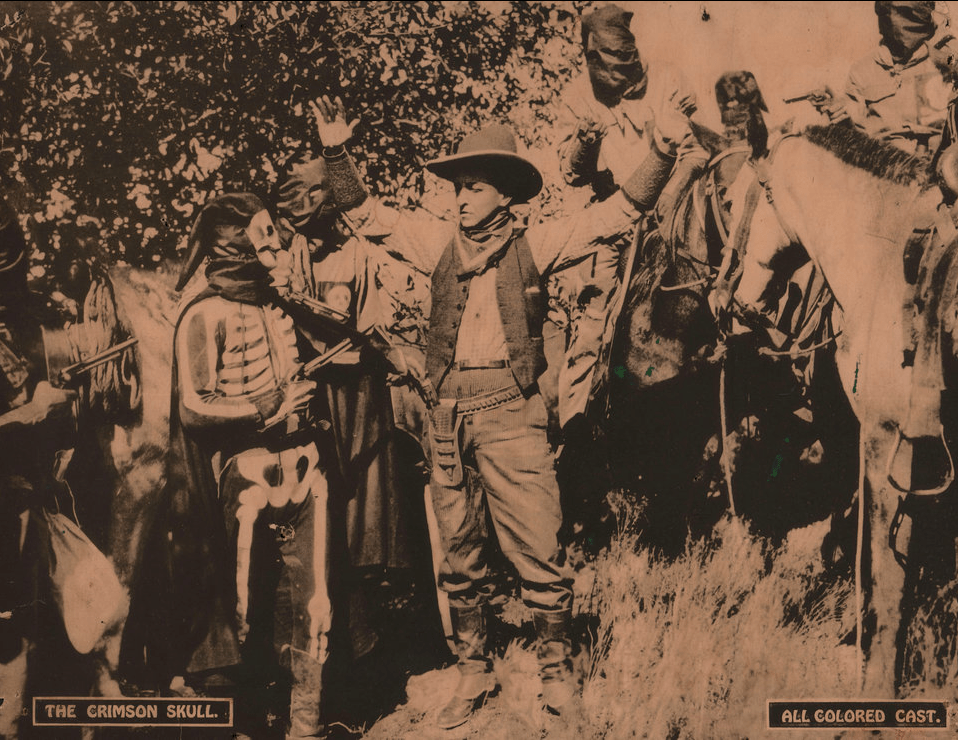
Story:  When the peaceful black city of Boley, Oklahoma falls under the control of an outlaw known as “The Skull” and his band of henchman, “The Terrors,” the Boley Law and Order League offers a one thousand-dollar reward for the Skull’s capture, dead or alive. The League also forces the resignation of the sheriff, a Skull puppet, and gives the job to the respected Lem Nelson, a cattleman and owner of the Crown C ranch. Bob Calem, the Crown C foreman, volunteers to infiltrate the Skull’s gang in order to hasten the criminals’ capture. When Steve Reynolds, a one-legged cowboy, and Anita Nelson, Lem’s daughter, as well as Bob’s sweetheart, are kidnapped by the gang, Bob helps them to escape.  He is accused of being a traitor, but the gang cannot decide whether Bob is guilty or innocent, so they leave his fate to the test of “The Crimson Skull,” in which one drop of blood will determine whether he lives or dies.

To rid the range of a gang of outlaws that are rustling cattle and robbing the banks and stagecoaches, cowhand Bob Calem, working on the gang-leader’s superstitions, dons a skeleton-costume to strike fear into the gang.
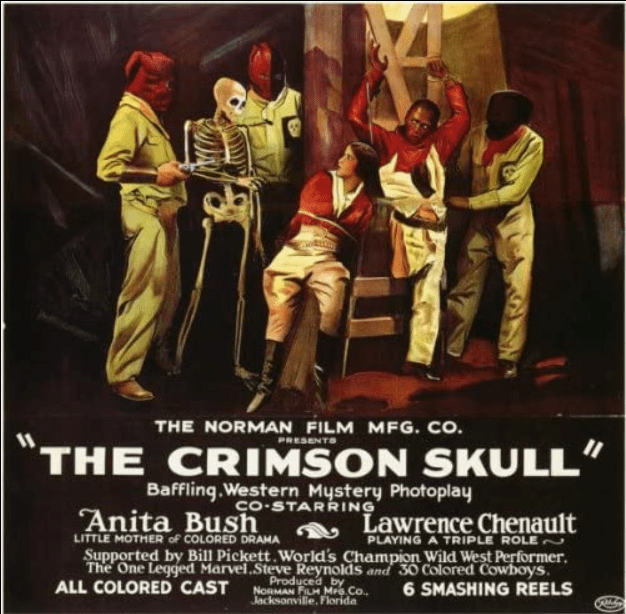
Notes:  Norman Film Manufacturing Co. was located in Jacksonville, FL. According to its pressbook, the film was produced in “the All-Colored City of Boley, Okla.” Lawrence Chenault, who played three roles, including the film’s hero and villain, had earlier been a member of the Anita Bush Dramatic Stock Company. Bush, who made her motion picture debut in The Crimson Skull, started acting in New York theater in 1903, and following her success at the Lincoln Theater in Harlem, became known as “The Little Mother of Colored Drama.” The pressbook stated that the film’s “action and story [are] on a par with white productions with the drawing feature of a cast composed entirely of colored artists. (There is not a white character in it.) And a story free from the usual mimicry of the colored man; free from ‘race problems’ that engender friction.” Publicity material stated that the cast included “30 colored cowboys.”  Source(s):  TCM; DAARAC.org; IMDB.
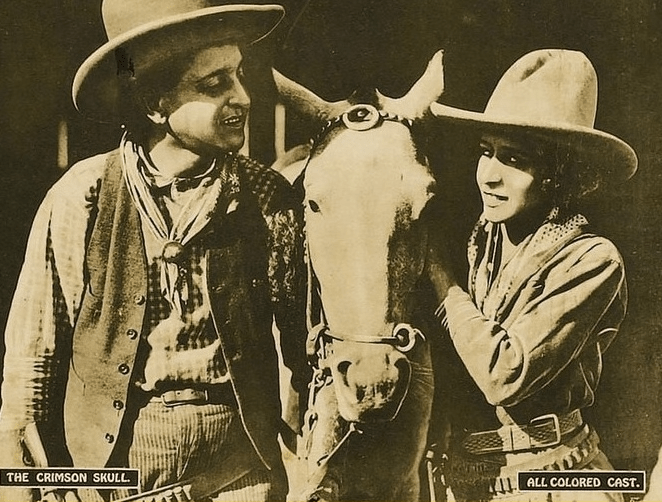
The Call of His People

Details
Year of Release:   7/15/1921
Genre:  Drama
Rating:  N/A
Runtime:   Unknown
Black & White
Silent
Studio:  Reol Productions Corp.

Cast
George Edward Brown
Edna Morton
Mae Kemp
James Steven
Lawrence Chenault
Mercedes Gilbert
Percy Verwayen
 
Synopsis

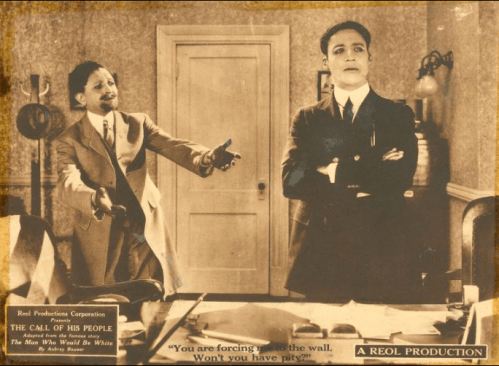
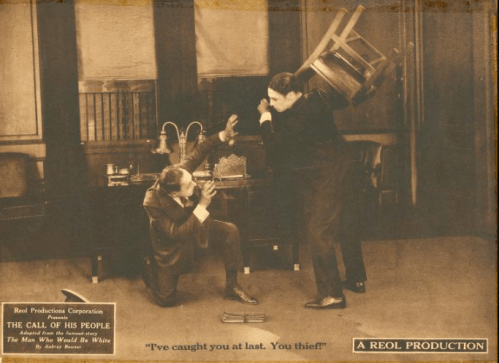
Nelson Holmes, an African American who has passed for White for twenty years, has advanced from office boy to the position of general manager at the Brazilian-American Coffee Syndicate.  One day Nelson is visited by James Graves, a boyhood friend from the South who is looking for a job as a Spanish correspondent. Fearing that his secret will be discovered, Nelson urges Graves to pose as a Spaniard, but Graves refuses. Finally Nelson agrees to make Graves his private secretary if he will remain quiet about Nelson’s true race.  Graves accepts, though he feels contempt for Nelson.  Deeply affected by seeing Graves again, Nelson pays a visit to Graves’ sister Elinor, who was his childhood sweetheart. Elinor is cold to him, angered by his denial of his own people. When a representative of the Santos Company, a competitor who is trying to put the Brazilian-American Coffee Syndicate out of business, offers Nelson a bribe to destroy some contracts that could ruin the company, Nelson indignantly refuses.  Their conversation is overheard by Beauregard Stuart, Nelson’s co-worker who was vexed that Nelson had received the promotion to general manager rather than him. That night, Graves overhears Stuart make a deal to get the contracts for the Santos representative. As Stuart is about to take the contracts from the company safe, Graves attacks him, and during their struggle, retrieves the contracts. After Graves runs off, Nelson returns to the office, and Stuart mistakes him for his attacker, then accuses him of the theft. The next morning, as Stuart is telling their boss, Lionel Weathering, that Nelson stole the contracts, Elinor arrives with the contracts and a letter from Graves, which proves Stuart’s guilt.  Nelson, extremely grateful for Elinor and Graves’ loyalty, finally informs his boss that he has been passing for white. Weathering assures Nelson that it is the quality and not the color of a man that counts, and Nelson asks Elinor for her hand in marriage, once again proud to be black.
Notes

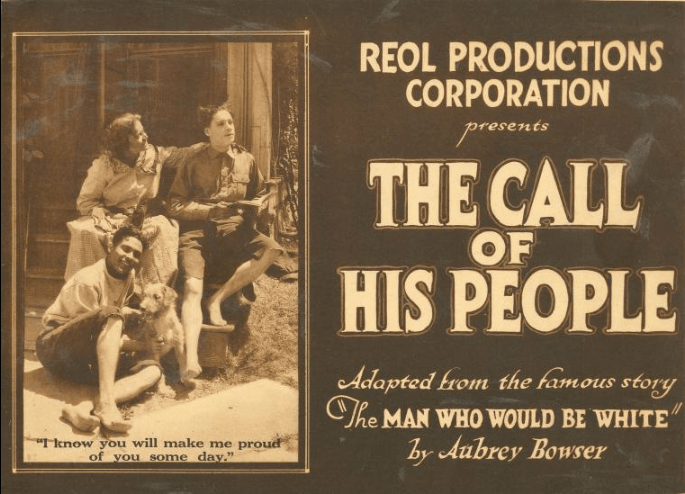
According to Early Race Filmmaking in America, the movie was based upon the serialized novel The Man Who Would Be White, by Aubrey Bowser.  Bowser’s pedigree featured prominently in the studio’s advertising for the film which states, “Aubrey Bowser…of the colored race and a graduate of Harvard University.”  George P. Johnson described the film as “Mixed cast of white and colored.  Expensive picture, and very good in all departments.  Probably best Negro picture made.  However little high class.”

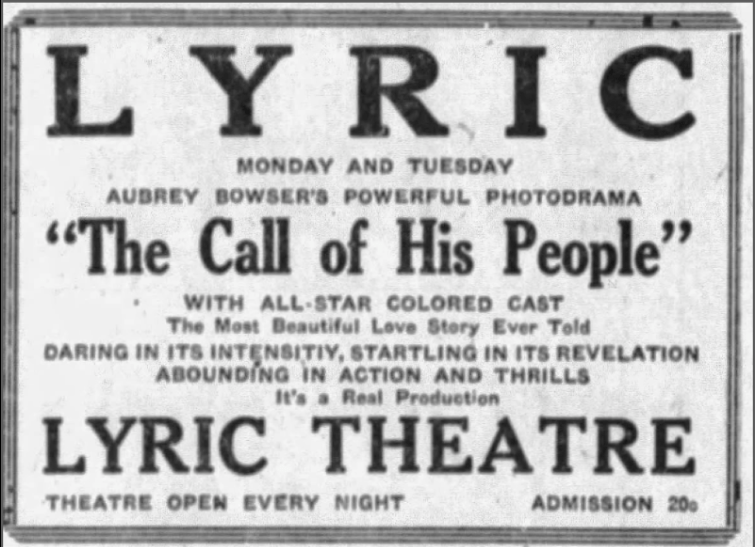
Reol’s advertising team appealed to racial pride to bring potential moviegoers to the theaters:

MOTHERS — FATHERS
DAUGHTERS – SONS:

If there is anything more binding between you and your Race than the color of your skin or the texture of your hair.  Or those few drops of Negro blood that cannot be detected In either; if you are really interested in our aims, our Achievements and our stations in life, don’t let your work, Scruples, age or anything else keep you from seeing

“THE CALL OF HIS PEOPLE”
Or
“THE MAN WHO WOULD BE WHITE”

Such advertising clearly touted the film as an example of black independent cinema, particularly since almost no mainstream films of this era considered the physiological aspects of race or the dreams and goals of the African-American population.  In his summary of the film, J.A. Jackson of Billboard, a mainstream white industry publication, wrote that it reflects “the ever present anxiety that is associated with the practice that has become so prevalent.”  This “anxiety” alluded to white fear of light-skinned African Americans passing for white.

Filmed at the Irvington-on-the-Hudson, NY estate of Black millionairess, A’Lelia Walker (daughter of Madam C. J. Walker).  Sources:  TMC; Early Race Filmmaking in America by Barbara Lupack (Editor); Daarac.org.

The Sport Of The Gods

Release Date:  4/23/1921
Genre:  Drama
Rating:  NR
Director:  Henry J. Vernot
Studio(s):  Reol Productions Corp.
Running Time:  Unknown
Silent
Black & White

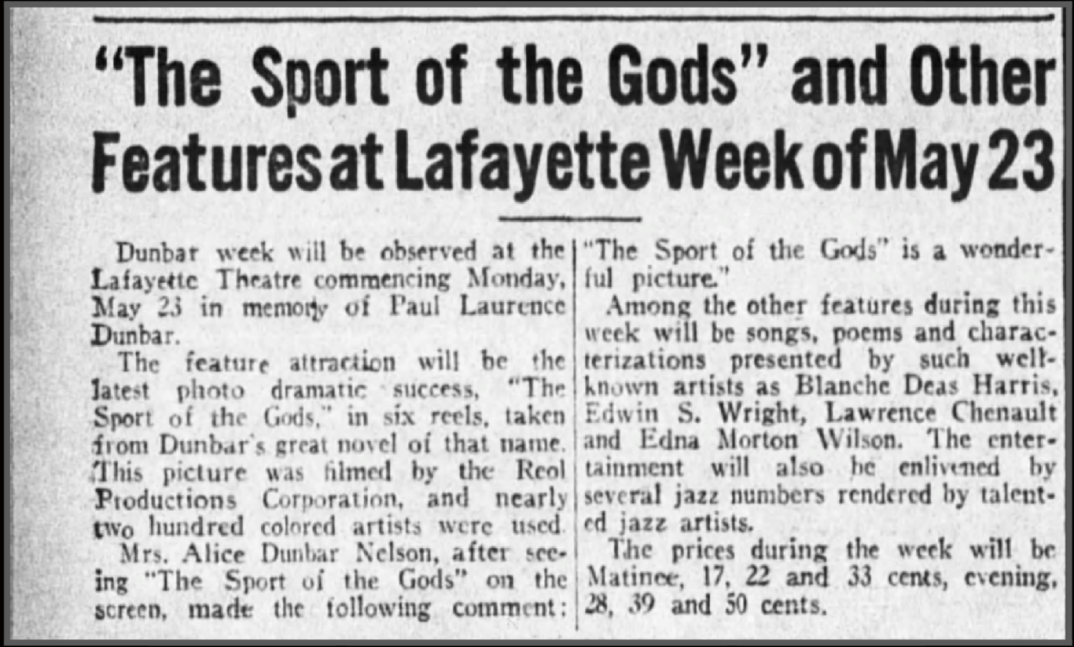
Cast:  Elizabeth Boyer (Kitty Hamilton), Edward R. Abrams (Jim Skaggs), George Edward Brown (Joe Hamilton), Leon Williams (Berry Hamilton), Lucille Browne (Fannie Hamilton), Lindsay J. Hall (Maurice Oakley), Jean Armour (Julia Oakley), Stanley Walpole (Francis Oakley), Walter Thomas (Thomas), Lawrence Chenault (Sadness), Ruby Mason (Mrs. Jones), Edna Morton (Hattie Sterling).

Story:  The story deals with a Black man who is unjustly sent to prison to save the reputation of his white employer’s son, a gambler.  His wife, son and daughter, move to New York rather to escape the scorn and gossip of their neighbors in Virginia. The son associates with evil companions and the daughter becomes a singer in an underworld cabaret where her character is placed in jeopardy. The mother, having been convinced that a prison sentence is the same as a divorce, is persuaded to marry a man who has schemed to get her money. The husband is finally released from jail after the real criminal confesses and he goes to New York to join his family, only to find his wife married. After numerous complications, all ends well.

Notes:  Based on the novel The Sport of the Gods by Paul Lawrence Dunbar.  Source(s):  TCM; DAARAC.org.

A Modern Cain

Details:
Year of Release:   1921
Genre:   Drama
Rating:  N/A
Studio:  J. W. Fife Productions
Director:   J. W. Fife
Black & White
Silent
Cast:   Norman Ward (William Moore), Ted Williams (Paul Moore), Fred J. Williams (Everett Moore), Vivian Carrols (Leonore Blackwell).
Synopsis:   William and Paul Moore are twin brothers who were orphaned at an early age and raised by their uncle.  When they grow up, William invests his inheritance in a business, but Paul squanders his share. They both fall in love with the same girl and Paul, who is jealous of William, pushes his brother off a cliff and reports him missing and presumed dead.  William survives the fall though he develops amnesia.  Fortunately, a doctor cures him, and William finds his way back home where he learns that Paul has died from drug addiction.  At last he is free to marry the girl he loves without further complication.
Source(s):   TCM; Within Our Gates: Ethnicity in American Feature Films, 1911-1960 by American Film Institute.

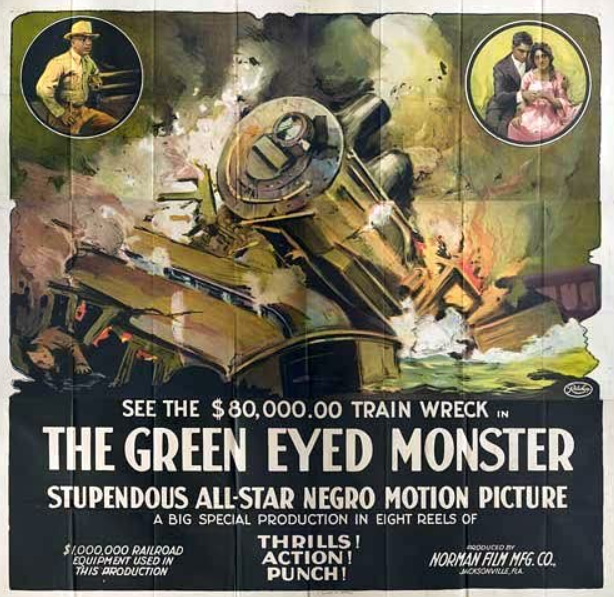
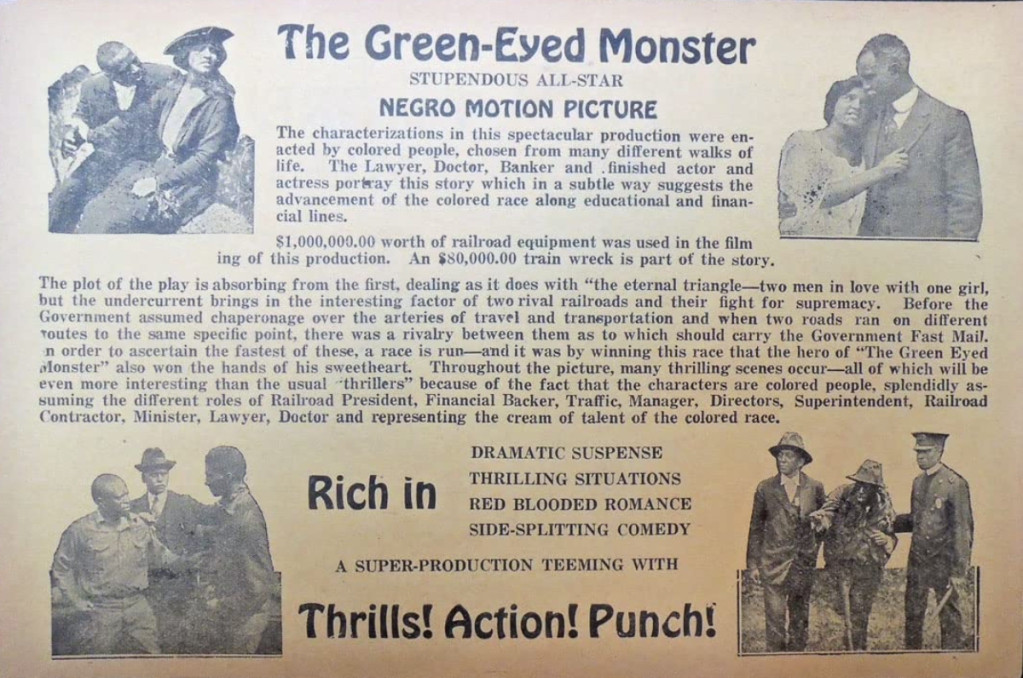
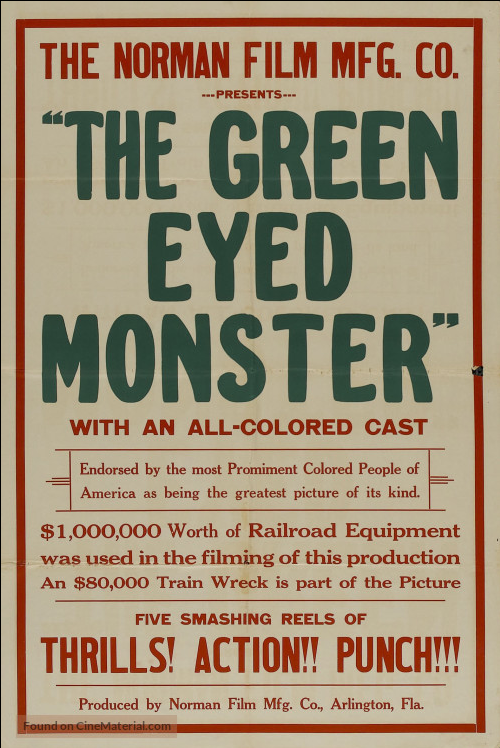
The Green-Eyed Monster

Release Date:  1919
Genre:  Action
Black & White
Silent
Studio(s):  Norman Film Manufacturing Company
Running Time: 50 mins.

Cast:  Jack Austin, Louise Dunbar, Steve Reynolds, Robert A. Stuart

Story:  “The plot deals with the eternal triangle, two men in love with one girl, but the undercurrents bring in the interesting factor of two rival railroads and their fight for supremacy. Before the Government assumed chaperonage over the arteries of travel and transportation and when two roads ran on different routes to the same specific point, there was a rivalry between them as to which should carry the Government Fast mail. In order to ascertain the fastest of these, a race is run – and it was by winning this race that the hero also won the hands of his sweetheart. $10,000 worth of railroad equipment was used and an $80,000 train wreck is part of the story.”

Notes:  The Norman Film Mfg. Co. was located in Jacksonville, FL. Publicity for this film stated, “There is not a white man in the cast, or is there depicted in the entire picture anything of the usual mimicry of the Negro. This photoplay has been indorsed [sic] by the most prominent colored people of America.” The publicity also stated that an $80,000 train wreck was filmed. A lobby card stated, “The characterizations in this spectacular production were enacted by colored people, chosen from many different walks of life. The Lawyer, Doctor, Banker and finished actor and actress portray this story which in a subtle way suggests the advancement of the colored race along educational and financial lines.”

Details:  Silent filmmaker Richard Norman first found success with local productions of a film called The Wrecker, featuring white casts living and working in the Midwestern and Southern towns he visited during the late 1910s. During this period, he lived and worked for a time in Chicago, home to a bustling community of African American artists, musicians and filmmakers – including one Oscar Micheaux, widely regarded as the father of black film.  Having befriended Micheaux (at least via letters) and intrigued by the niche market potential of “race films” starring black actors playing all roles – heroes and villains, alike – Norman set about a new genre of film. He took a chance on the localized successes of The Wrecker, retooled the script, hired an all-black cast and produced The Green Eyed Monster in 1919.

It was a bit of a risk that initially proved a failure. African American audiences responded favorably to the dramatic story of racial uplift and achievement expressed in the film, but were unimpressed with the new comedic elements. So, Norman headed back into the editing room, cutting the comedic elements and remixing them into their own slapstick romantic comedy called The Love Bug. In 1920, he re-released The Green Eyed Monster as a dramatic film and often screened The Love Bug as a pre-feature extra. The combination proved successful.

In fact, so successful was The Green Eyed Monster in distribution that George P. Johnson of the Lincoln Motion Picture Co., a contemporary of Norman Studios also producing race films, called it the “most sensational negro film made.”  “Sensational” certainly is an apt description. The Green Eyed Monster centers on a passionate love triangle and a cut-throat competition between two train companies to land a high-dollar mail contract. Scenes included a rescue from burning car, fist fights, a pistol duel, an abduction, a locomotive chase, and a violent train wreck reported to cost $80,000 to produce – a fortune in those days. The Green Eyed Monster also was the film debut for Steve “Peg” Reynolds, the longtime friend and “one-legged marvel” who would appear in all of Norman’s race films and accompany him to promote film premieres.

Unfortunately, no known clips of the film survive.  Source(s):  daaracarchive.org; tcm.com; normanstudios.org.

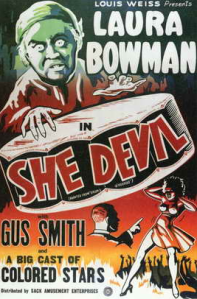
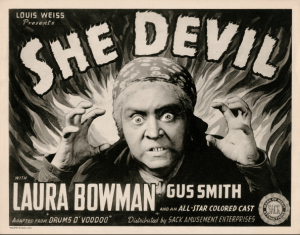
Drums O’ Voodoo

a/k/a Louisiana
a/k/a She Devil
a/k/a Voodoo Devil Drums
a/k/a Voodoo Drums

 Details:

Year of Release:  1934
B&W
Genre:  Horror
Runtime:  70 mins.
Studio(s): Sack Amusement Enterprises
Director:  Arthur Hoerl

Cast:

Laura Bowman (Aunt Hagar), Edna Barr (Myrtle Simpson), Lionel Monagas (Ebenezer), J. Augustus Smith (Amos Berry), Morris McKenny (Thomas Catt), A. B. Comathiere (Deacon Dunson), Alberta Perkins, (Sister Knight), Fred Bonny (Brother Zero), Paul Johnson (Deacon August), Trixie Smith (Sister Marguerite), Carrie Huff (Sister Zuzan)

 Story:

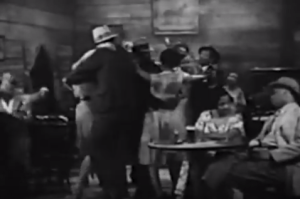
Thomas Catt, the proprietor of a “jook,” a Southern cabaret-brothel, desires young, virginal Myrtle Simpson, the niece of preacher Amos Berry and fiancée of the grandson of Aunt Hagar, the local voodoo high priestess.
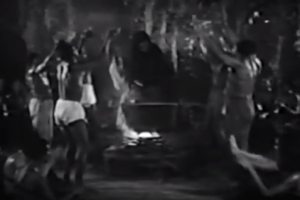
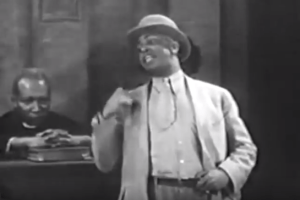
Although Catt threatens to expose Amos’ past to his congregation if he refuses to “give” Myrtle to him, Amos resists Catt’s attempts at blackmail, while Aunt Hagar activates some of her voodoo spells.

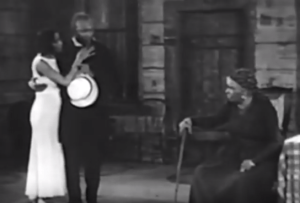
Later, during one of Amos’ spirited revival meetings, Catt bursts in and, after drawing his razor, announces that he has come to claim Myrtle. Defied by both Aunt Hagar’s grandson and Amos, Catt starts to reveal to the congregation that Amos had once murdered a man. In the middle of his exposé, however, Catt is struck by a bolt of lightning and is blinded, a fate that had been predicted by Aunt Hagar. Catt is then smothered in a pool of quicksand, and Myrtle and Amos are at last freed from their tormentor.
 

Notes:

The New York State Censor Board records from 1934 indicate that the film was retitled The DevilDrums o’ Voodoo was re-released in 1940 under the title She Devil.  In 1981, the film was found in a warehouse by historian-producer Alex Gordon.

The screenplay was based on the stage play, Louisiana, by J. Augustus Smith.  Most of the all-black cast, including playwright J. Augustus Smith, also appeared in the stage play, which was produced on Broadway by the Negro Theatre Guild.  The play was one act long and was only performed eight times, partly because of the criticism of Brooks Atkinson of New York Times.

Modern sources list the title as Voodoo Devil Drums and Voodoo Drums.  Additional cast members from modern sources include James Davis (Brother Zumee), Ruth Morrison (Sister Gaghan), Harriet Daughtry (Sister Lauter), Bennie Small (Bou Bouche), Pedro Lopez (Marcon), Jennie Day, Gladys Booker, Herminie Sullivan, Lillian Exum, Edith Woodby, Mabel Grant, Marion Hughes, Madeline Smith, Theresa Harris, Dorothy St. Claire, Eleanor Hines, Pauline Freeman, Annabelle Smith, Jacquiline Ghant, Annabelle Ross and Harriett Scott (Members of the Flat Rock Washfoot Baptist Church), Cherokee Thornton, Arthur McLean, DeWitt Davis, Rudoph Walker, Marvin Everhart, Jimmie Cook, Irene Bagley, Sally Timmons, Beatrice James and Marie Remsen (Voodoo Dancers).  Source(s):  TCM, DAARAC,org, Movieposters.

Movie