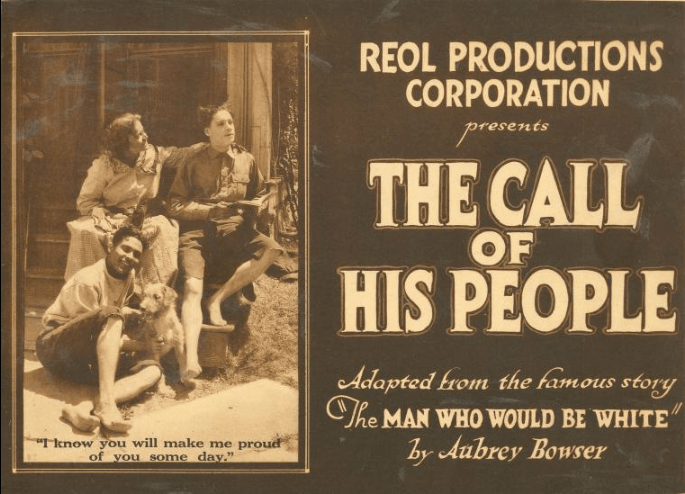
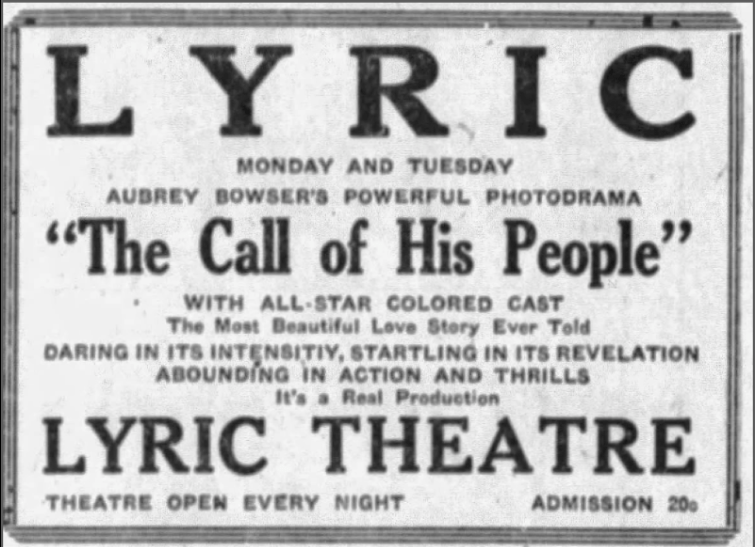
The Call of His People

Details
Year of Release:   7/15/1921
Genre:  Drama
Rating:  N/A
Runtime:   Unknown
Black & White
Silent
Studio:  Reol Productions Corp.

Cast
George Edward Brown
Edna Morton
Mae Kemp
James Steven
Lawrence Chenault
Mercedes Gilbert
Percy Verwayen
 
Synopsis

Nelson Holmes, an African American who has passed for White for twenty years, has advanced from office boy to the position of general manager at the Brazilian-American Coffee Syndicate.  One day Nelson is visited by James Graves, a boyhood friend from the South who is looking for a job as a Spanish correspondent. Fearing that his secret will be discovered, Nelson urges Graves to pose as a Spaniard, but Graves refuses. Finally Nelson agrees to make Graves his private secretary if he will remain quiet about Nelson’s true race.  Graves accepts, though he feels contempt for Nelson.  Deeply affected by seeing Graves again, Nelson pays a visit to Graves’ sister Elinor, who was his childhood sweetheart. Elinor is cold to him, angered by his denial of his own people. When a representative of the Santos Company, a competitor who is trying to put the Brazilian-American Coffee Syndicate out of business, offers Nelson a bribe to destroy some contracts that could ruin the company, Nelson indignantly refuses.  Their conversation is overheard by Beauregard Stuart, Nelson’s co-worker who was vexed that Nelson had received the promotion to general manager rather than him. That night, Graves overhears Stuart make a deal to get the contracts for the Santos representative. As Stuart is about to take the contracts from the company safe, Graves attacks him, and during their struggle, retrieves the contracts. After Graves runs off, Nelson returns to the office, and Stuart mistakes him for his attacker, then accuses him of the theft. The next morning, as Stuart is telling their boss, Lionel Weathering, that Nelson stole the contracts, Elinor arrives with the contracts and a letter from Graves, which proves Stuart’s guilt.  Nelson, extremely grateful for Elinor and Graves’ loyalty, finally informs his boss that he has been passing for white. Weathering assures Nelson that it is the quality and not the color of a man that counts, and Nelson asks Elinor for her hand in marriage, once again proud to be black.
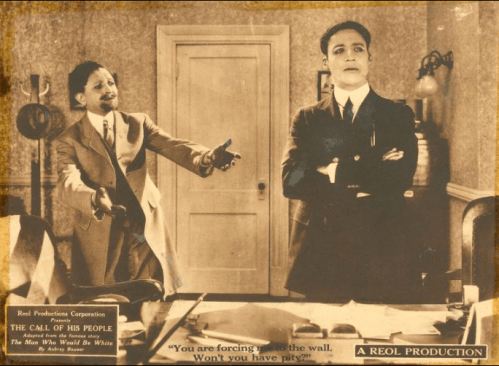
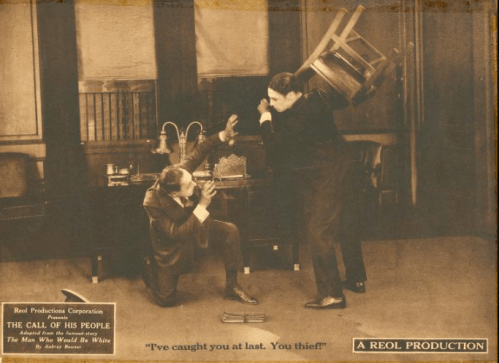
Notes

According to Early Race Filmmaking in America, the movie was based upon the serialized novel The Man Who Would Be White, by Aubrey Bowser.  Bowser’s pedigree featured prominently in the studio’s advertising for the film which states, “Aubrey Bowser…of the colored race and a graduate of Harvard University.”  George P. Johnson described the film as “Mixed cast of white and colored.  Expensive picture, and very good in all departments.  Probably best Negro picture made.  However little high class.”

Reol’s advertising team appealed to racial pride to bring potential moviegoers to the theaters:

MOTHERS — FATHERS
DAUGHTERS – SONS:

If there is anything more binding between you and your Race than the color of your skin or the texture of your hair.  Or those few drops of Negro blood that cannot be detected In either; if you are really interested in our aims, our Achievements and our stations in life, don’t let your work, Scruples, age or anything else keep you from seeing

“THE CALL OF HIS PEOPLE”
Or
“THE MAN WHO WOULD BE WHITE”

Such advertising clearly touted the film as an example of black independent cinema, particularly since almost no mainstream films of this era considered the physiological aspects of race or the dreams and goals of the African-American population.  In his summary of the film, J.A. Jackson of Billboard, a mainstream white industry publication, wrote that it reflects “the ever present anxiety that is associated with the practice that has become so prevalent.”  This “anxiety” alluded to white fear of light-skinned African Americans passing for white.

Filmed at the Irvington-on-the-Hudson, NY estate of Black millionairess, A’Lelia Walker (daughter of Madam C. J. Walker).  Sources:  TMC; Early Race Filmmaking in America by Barbara Lupack (Editor); Daarac.org.
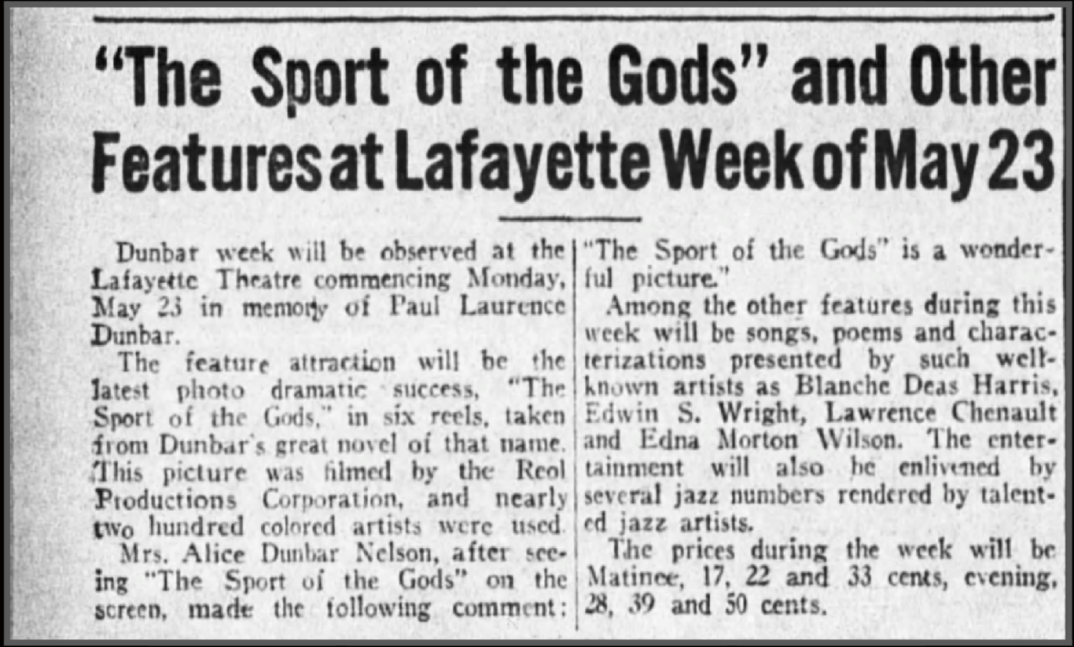
The Sport Of The Gods

Release Date:  4/23/1921
Genre:  Drama
Rating:  NR
Director:  Henry J. Vernot
Studio(s):  Reol Productions Corp.
Running Time:  Unknown
Silent
Black & White

Cast:  Elizabeth Boyer (Kitty Hamilton), Edward R. Abrams (Jim Skaggs), George Edward Brown (Joe Hamilton), Leon Williams (Berry Hamilton), Lucille Browne (Fannie Hamilton), Lindsay J. Hall (Maurice Oakley), Jean Armour (Julia Oakley), Stanley Walpole (Francis Oakley), Walter Thomas (Thomas), Lawrence Chenault (Sadness), Ruby Mason (Mrs. Jones), Edna Morton (Hattie Sterling).

Story:  The story deals with a Black man who is unjustly sent to prison to save the reputation of his white employer’s son, a gambler.  His wife, son and daughter, move to New York rather to escape the scorn and gossip of their neighbors in Virginia. The son associates with evil companions and the daughter becomes a singer in an underworld cabaret where her character is placed in jeopardy. The mother, having been convinced that a prison sentence is the same as a divorce, is persuaded to marry a man who has schemed to get her money. The husband is finally released from jail after the real criminal confesses and he goes to New York to join his family, only to find his wife married. After numerous complications, all ends well.

Notes:  Based on the novel The Sport of the Gods by Paul Lawrence Dunbar.  Source(s):  TCM; DAARAC.org.

The Secret Sorrow

Details

Release Date:   10/1/1921
Genre:  Drama
Rating:  N/A
Studio:  Reol Productions Corp.
Writer:  S. C. Brown
Black & White
Silent

Cast

George Edward Brown, Percy Verwayen, Edna Morton, Lawrence Chenault, Inez Clough, Ida Anderson

Synopsis

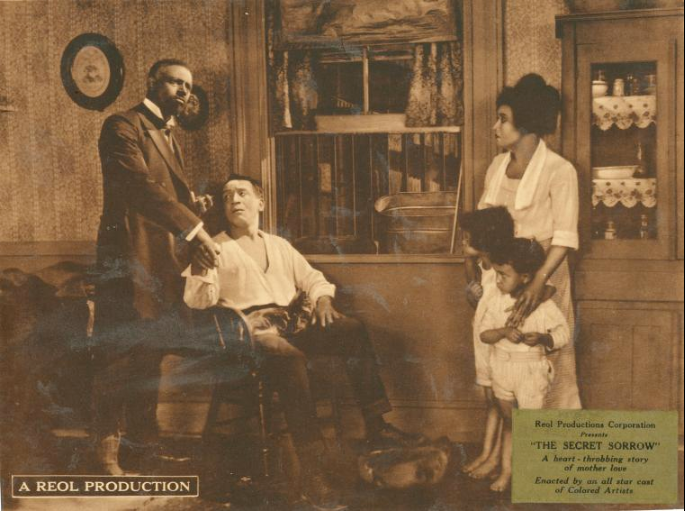
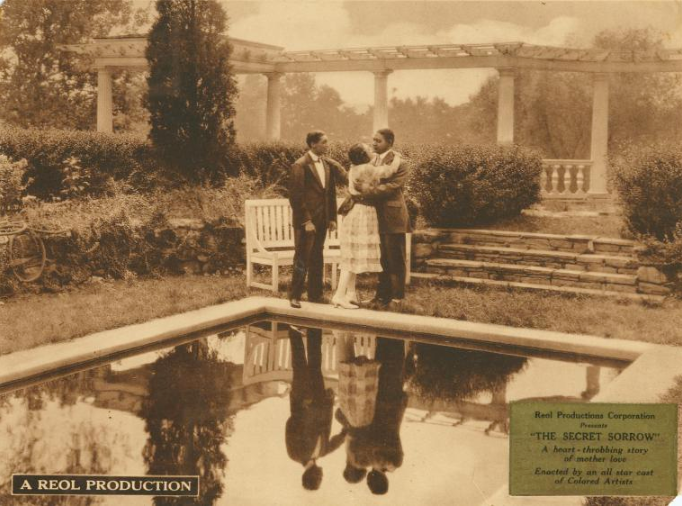
Anne Morgan, a poverty-stricken woman decides to give up one of her two sons to a prominent doctor willing to adopt him. The doctor names the child Arthur and sends him to law school, after which he becomes the assistant district attorney of New York.  Meanwhile, the other brother, Joe, raised by his mother, grows up to be a notorious gangster.  Joe works for Sam Dungan, a crooked politician and owner of several notorious dives.

When Joe is falsely accused of murder, Arthur is assigned to the case as the prosecuting attorney.  During the trial, Arthur calls Anne to the stand, not realizing that she is his own mother, and accuses her of moral degeneracy as he tries to paint an evil portrait of Joe. Dungan’s daughter Grace, who is Arthur’s sweetheart, discovers the truth about the brothers, and after finding the real murderer, sees that the mother and her sons are reunited. She then joins the happy family as Arthur’s bride.

This film is considered lost.  Sources:  Daarac.org; TCM.


The Lure Of A Woman

Release Date:  8/21/1921
Genre:  Drama
Rating:  NR
Director:  J.M. Simms
Studio:  Progress Picture Association
Running Time:  75 mins.
B&W
Silent

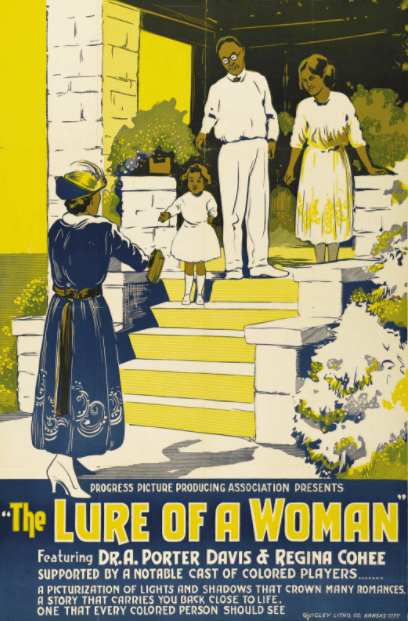
Cast:  John Cobb, Regina Cohee, Dr. A. Porter Davis, Lenore Jones, Alonzo Nixon, Regina Taylor

Details:  According to information in the George P. Johnson Collection at the UCLA Special Collections Library, this was the first release of The Afro-American Film Exhibitors Co. of Kansas City, Missouri. An advertisement called the film “the first Negro production ever made in Kansas City” and stated, “All the cast in this production are Kansas City Negroes. All the scenes were taken about the city.” Charles H. Allen, the male lead, was the general manager and treasurer of the company. They planned a series of eight films that would be released in Central and South America, as well as in the U.S., and boasted of a distribution policy “that will enable it to overcome some of the difficulties usual to colored pictures.” Their second release was to be called The Human Devil.

There is no  information available regarding the plot of this film.

An item in the 14 May 1922 Kansas City Kansan reported that a print of the film caught fire during a screening at Western University. The audience was evacuated, and only the film print was burned.

Source(s):  TCM; IMDB; American Film Institute (AFI) catalog.  Photo Source:  Wiki Commons.

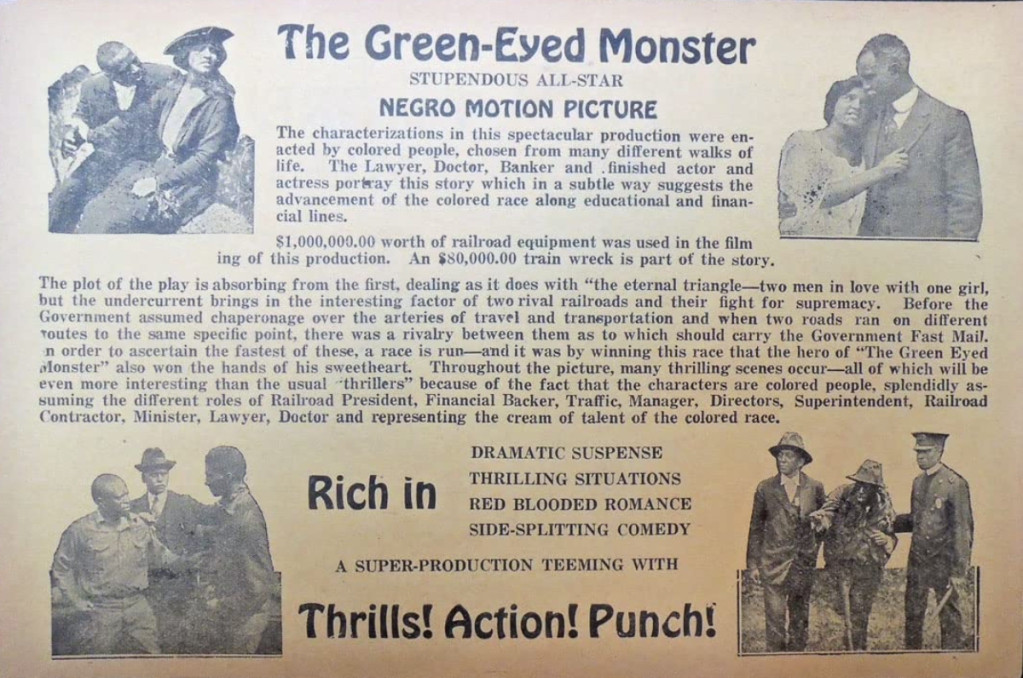
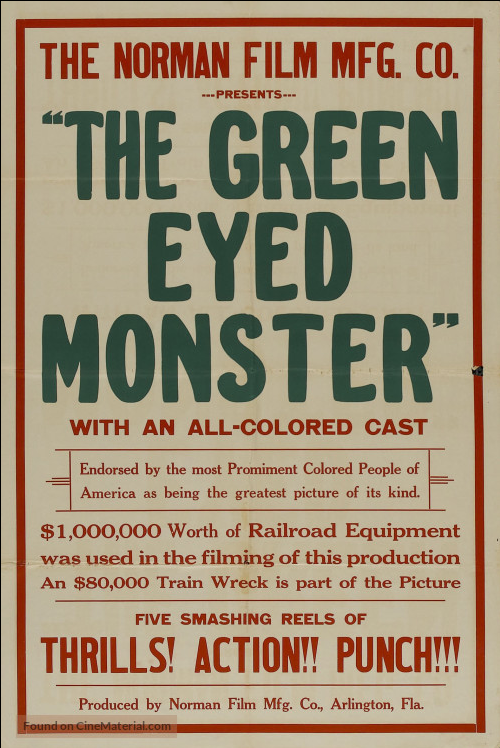
The Green-Eyed Monster

Release Date:  1919
Genre:  Action
Black & White
Silent
Studio(s):  Norman Film Manufacturing Company
Running Time: 50 mins.

Cast:  Jack Austin, Louise Dunbar, Steve Reynolds, Robert A. Stuart

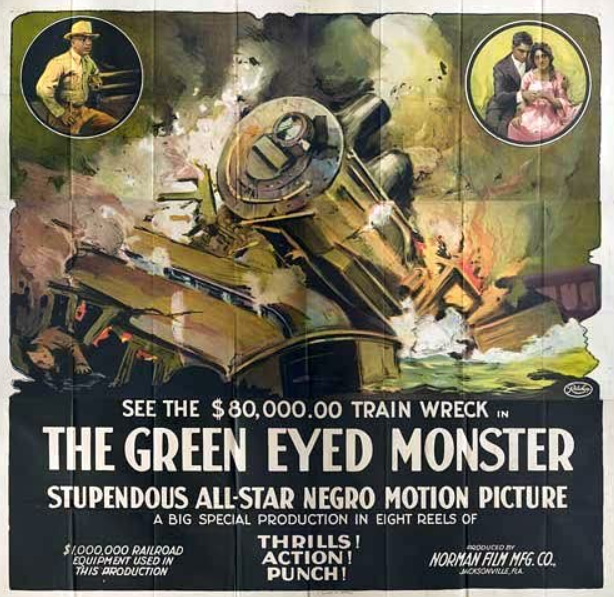
Story:  “The plot deals with the eternal triangle, two men in love with one girl, but the undercurrents bring in the interesting factor of two rival railroads and their fight for supremacy. Before the Government assumed chaperonage over the arteries of travel and transportation and when two roads ran on different routes to the same specific point, there was a rivalry between them as to which should carry the Government Fast mail. In order to ascertain the fastest of these, a race is run – and it was by winning this race that the hero also won the hands of his sweetheart. $10,000 worth of railroad equipment was used and an $80,000 train wreck is part of the story.”

Notes:  The Norman Film Mfg. Co. was located in Jacksonville, FL. Publicity for this film stated, “There is not a white man in the cast, or is there depicted in the entire picture anything of the usual mimicry of the Negro. This photoplay has been indorsed [sic] by the most prominent colored people of America.” The publicity also stated that an $80,000 train wreck was filmed. A lobby card stated, “The characterizations in this spectacular production were enacted by colored people, chosen from many different walks of life. The Lawyer, Doctor, Banker and finished actor and actress portray this story which in a subtle way suggests the advancement of the colored race along educational and financial lines.”

Details:  Silent filmmaker Richard Norman first found success with local productions of a film called The Wrecker, featuring white casts living and working in the Midwestern and Southern towns he visited during the late 1910s. During this period, he lived and worked for a time in Chicago, home to a bustling community of African American artists, musicians and filmmakers – including one Oscar Micheaux, widely regarded as the father of black film.  Having befriended Micheaux (at least via letters) and intrigued by the niche market potential of “race films” starring black actors playing all roles – heroes and villains, alike – Norman set about a new genre of film. He took a chance on the localized successes of The Wrecker, retooled the script, hired an all-black cast and produced The Green Eyed Monster in 1919.

It was a bit of a risk that initially proved a failure. African American audiences responded favorably to the dramatic story of racial uplift and achievement expressed in the film, but were unimpressed with the new comedic elements. So, Norman headed back into the editing room, cutting the comedic elements and remixing them into their own slapstick romantic comedy called The Love Bug. In 1920, he re-released The Green Eyed Monster as a dramatic film and often screened The Love Bug as a pre-feature extra. The combination proved successful.

In fact, so successful was The Green Eyed Monster in distribution that George P. Johnson of the Lincoln Motion Picture Co., a contemporary of Norman Studios also producing race films, called it the “most sensational negro film made.”  “Sensational” certainly is an apt description. The Green Eyed Monster centers on a passionate love triangle and a cut-throat competition between two train companies to land a high-dollar mail contract. Scenes included a rescue from burning car, fist fights, a pistol duel, an abduction, a locomotive chase, and a violent train wreck reported to cost $80,000 to produce – a fortune in those days. The Green Eyed Monster also was the film debut for Steve “Peg” Reynolds, the longtime friend and “one-legged marvel” who would appear in all of Norman’s race films and accompany him to promote film premieres.

Unfortunately, no known clips of the film survive.  Source(s):  daaracarchive.org; tcm.com; normanstudios.org.

The Colored American Winning His Suit

Details:
Year of Release: 1916
Genre: Drama
Rating: N/A
Runtime: Unknown
Silent
Black & White
Studio:  Frederick Douglass Film Company

Cast: 
Thomas M. Mosley (Bob Winall)
Ida Askins (Alma Elton)
Florence Snead (Bessie Winall)
Marshall Davies (Jim Sample)
F. King (Mr. Hinderus)
Fred Leighton (Colonel Goodwill)

Synopsis:

Freed from slavery after the Civil War, the Winalls rent a farm from their former master. They prosper, eventually buy the farm, and have two children, Bob and Bessie, whom they send to college. Returning home as a lawyer, Bob falls in love with Bessie’s roommate Alma Eaton, however her mother wants her to marry a wealthy man instead. But when Alma’s father gets into trouble with the law, Bob goes up against a white man, Mr. Hinderus, in court and with the help of Colonel Goodwill, saves the day.  The white man’s attempt to “hinderus” having failed, clearing the way for Bob’s marriage to Alma.

Notes:

First feature film made by a Black production company.  The Frederick Douglass Film Company of New Jersey, whose officers included some of the most prominent black citizens of Jersey City and whose purpose was “to give the public motion pictures which do not degrade the race.”  According to the press book, The Colored American Winning His Suit was aimed “to offset the evil effects of certain photo plays that have libeled the Negro and criticized his friends; to bring about a better and more friendly understanding between the white and colored races; to inspire in the Negro a desire to climb higher in good citizenship, business, education and religion.”

The New York Age (July 20, 1916), hailed the film as “the first five-reel Film Drama written, directed, acted and produced by Negroes” and praised the company, which was “owned and operated by Negroes” and “whose aim is to present the better side of Negro life, and to use the screen as a means of bringing about better feeling between the races.”

The cast was made up of non-actors from the Jersey City, NJ area. Scenes were shot in Virginia, Jersey City, and at Howard University in Washington, D.C.

This film is considered lost.

Source(s):  TCM; Literary Adaptations in Black American Cinema: From Micheaux to Toni Morrison by Barbara Tepa Lupack; IMDB.