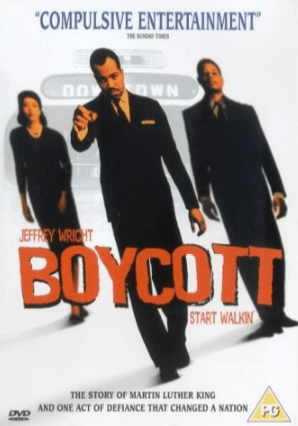
Release Date: 2/20/01; TV Movie (HBO) Genre: Drama/Based on Actual Events Rating:PG Director: Clark Johnson Studio(s): HBO Films, Norman Twain Productions, Shelby Stone Productions Running Time: 113 mins.
Cast: Jeffrey Wright (Dr. Martin Luther King, Jr.), Terrence Howard (Ralph Abernathy), CCH Pounder (Jo Ann Robinson), Carmen Ejogo (Coretta Scott King), Reg E. Cathey (E.D. Nixon), Brent Jennings (Rufus Lewis), Iris Little Thomas (Rosa Parks), Shawn Michael Howard (Fred Gray), Erik Dellums (Bayard Rustin), Mike Hodge (Daddy King), Whitman Mayo (Reverend Banyon), Walter Franks (Reverend Fields).
Story: Boycott is a behind-the-scenes look at the famous Montgomery Bus Boycott of 1955. When Rosa Parks, a black, upstanding citizen of the community, defiantly refuses to give up her seat on the bus to a white man, she sets in motion a tumultuous string of events. Her arrest is the catalyst for a one-day bus boycott to protest segregation. A young preacher, Dr. Martin Luther King, Jr., is selected as head of the newly formed Montgomery Improvement Association, the organization that will lead the boycott.
Using archival footage to establish the strained atmosphere of the era, the film is a dramatization of the one-day event which turned into a standoff that lasted well over a year and gave rise to some of the greatest leaders of the nonviolent civil rights movement. Source(s): commonsensemedia.org; Google; readthespirit.com; Shadow & Act; Cos’ Blog.
Release Date: 1/21/17 – Sundance Film Festival; 11/17/17 – Netflix Genre:Drama Rating: R Director: Dee Rees Studio(s):Armory Films, ArtImage Entertainment, Black Bear Pictures, Elevated Films (II), MACRO, MMC Joule Films, Zeal Media, Netflix. Running Time: 134 mins.
Cast:Jason Mitchell as Ronsel Jackson, Mary J. Blige as Florence Jackson, Jason Clarke as Henry McAllan, Rob Morgan as Hap Jackson, Carey Mulligan as Laura McAllan, Garrett Hedlund as Jamie McAllan, Jonathan Banks as Pappy McAllan, Frankie Smith as Marlon Jackson, Kennedy Derosin as Lilly May Jackson, Elizabeth Windley as Amanda Leigh McAllan, Piper Blaire as Isabelle McAllan, Jason Kirkpatrick as Orris Stokes, Kerry Cahill as Rose Tricklebank, Oyeleke Oluwafolakanmi as Cleve, Kelvin Harrison, Jr. as Weeks, Lucy Faust as Vera Atwood, Dylan Arnold as Carl Atwood, Samantha Höefer as Resl, Geraldine Singer as Mrs. Chappell, Henry Frost as Teddy Chappell., Claudio Laniado as Dr. Pearlman, Charley Vance as Sheriff Thacker.
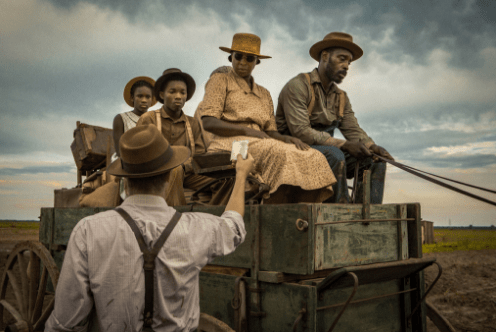
Details: Based on the novel of the same name by Hillary Jordan, the film depicts the story of two men, one black, the other white, who return home from World War II to work on a farm in rural Mississippi, where they struggle to deal with racism and adjusting to life after war.
Story: During a rain storm in Mississippi delta farm country, foolish and heartless Henry McAllan and his younger brother Jamie struggle to lower their deceased Pappy’s coffin into the grave they’d just dug. The Jacksons, a black share-cropper family they know, are passing by in a wagon. Henry asks the father, Hap, for help but seems uncomfortably asking while Hap hesitates to reply.
Flash back to 1939, Henry buys a farm outside the fictional town of Marietta, Mississippi and moves there with his wife Laura, their daughters and his racist father, Pappy. The Jackson family, led by tenant farmer Hap and his wife Florence, work the farm’s cotton field and dream of owning their own land one day.
As World War II begins, Jamie and the Jacksons’ eldest son, Ronsel, join the military and both experience severe combat trauma. When the war ends, Ronsel and Jamie return home. They’ve changed, but the local society hasn’t. Both men suffer from PTSD while Jamie becomes an alcoholic, Ronsel who appreciated the relative lack of racism in Europe struggles with racism back home. They become aware of one anothers’ difficulties, and bond over them.
Later, Ronsel receives a letter telling him that a German woman with whom he’d been romantically involved during the war has a child and wants him to join them. Pappy finds the letter and rounds up several Ku Klux Klan pals, who find Ronsel, beat him, and prepare to lynch him. Pappy who disapproves of Jamie’s friendship with Ronsel, brings Jamie to the lynching site, where Jamie iss beaten and tied up. Pappy and the Kluxers tell Jamie to choose Ronsel’s punishment for his “crime” — to lose his eyes, tongue or testicles — and if refuses to choose he must watch Ronsel be put to death. Jamie chooses tongue and Ronsel’s tongue is cut out. Later that night, Jamie smothers Pappy to death.
The film returns to the opening scene. Hap helps with the coffin and after the coffin is lowered we Hap says a prayer over the grave, reciting from the Book of Job, verses 14:2-12 in criticism of Pappy. Before the wagon pulls away, Jamie gives the German woman’s envelope to Ronsel’s mother, and asks that she give it to Ronsel.
The Jacksons have their meager belongings in the wagon because they are leaving. Jamie moves to Los Angeles and Ronsel makes his way back to Europe where he reunites with the German woman, and their son. Source: IMDB; Wikipedia.
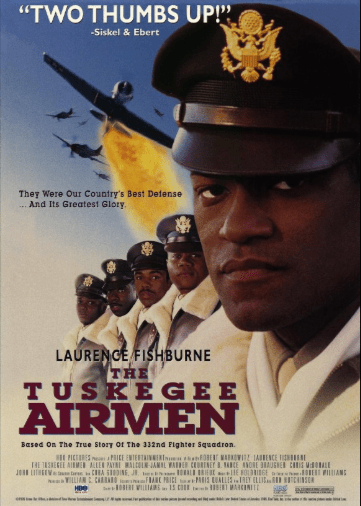
Release Date: 8/26/95; TV Movie (HBO) Genre:Drama/Historical Rating: PG-13 Director:Robert Markowitz Studio(s):HBO Films, Price Entertainment Running Time: 106 mins.
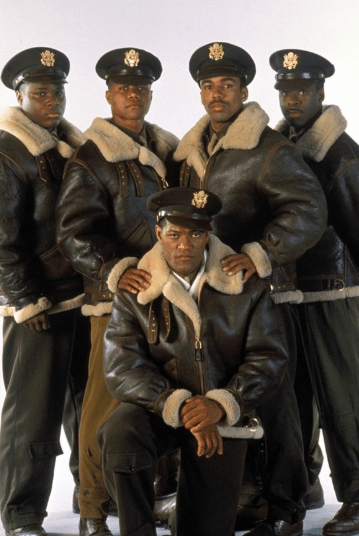
Cast:Laurence Fishburne (Capt. Hannibal “Iowa” Lee, Jr.), Allen Payne (Cadet Walter Peoples), Malcolm-Jamal Warner (Lt. Leroy Cappy), Courtney B. Vance (2ndLt. Glenn), Andre Braugher (Col. Benjamin O. Davis Jr.), Christopher McDonald (Maj. Sherman Joy), Daniel Hugh Kelly (Col. Rogers), John Lithgow (Sen. Conyers), Cuba Gooding, Jr. (Lt. Billy “A-Train” Roberts), Mekhi Phifer (Cdt. Lewis Johns), Rosemary Murphy (Eleanor Roosevelt).
Story: The Tuskegee Airmen is a 1995 HBO television movie based on the first African-American combat pilots in the United States Army Air Corps that fought in World War II. During World War II, Hannibal Lee (Laurence Fishburne), traveling by train to Tuskegee, Alabama, is joined by fellow flight cadet candidates Billy “Train” Roberts (Cuba Gooding, Jr.), Walter Peoples III (Allen Payne), and Lewis Johns (Mekhi Phifer). At the start of their training, they are met by Colonel Noel Rogers, the commander of the base; Major Sherman Joy, director of training; and Second Lieutenant Glenn (Courtney B. Vance), liaison officer. The cadets are briefed by Rogers and Joy, both with their own views that set the tone for what the cadets would later face in training: Rogers has an optimistic view, wanting the cadets to prove the naysayers wrong and letting them know how much of an honor it would be for them to pass the training and earn their wings as aviators. Major Joy, however, reflects the views of most of white America at the time, belittling the cadets and questioning whether they are up to the task.
While the cadets begin their classes, Major Joy begins his ploy to discredit the cadets. During a classroom session, Joy has them retake the same flight exam they had to take to get into the program. Later, he takes Peoples on a flight after it is revealed that Peoples has a commercial pilot license. Joy takes the training aircraft through tricky and dangerous moves to try and break People’s will, but the tactic doesn’t work. Afterwards, Joy explains to Colonel Rogers that some of the cadets may have cheated to get into the program. Rogers informs Joy that no one scored less than a 95 on the retest, and scorns Joy about his tactics.
After a briefing with the cadets, Major Joy sends each cadet on flights in their training aircraft with an instructor pilot. Cadet Johns, struggles to get his aircraft out of a stall. The instructor also tries to regain control but the plane crashes into a building, killing both Johns and his instructor. The cadets continue their training, flying with their instructor pilots and controlling the planes on their own. Major Joy even lets Cadet Lee make several solo flights around the Base.
Peoples performs some unauthorized aerobatic maneuvers which catches the attention of Colonel Rogers and Major Joy, and results in him being removed from the training program. Peoples pleads with them not to put him out of the program, but to no avail. To avoid going home in disgrace, an emotionally distraught Peoples commandeers an AT-6 plan and commits suicide by deliberately crashing it.
Back at the cadets’ barracks, tensions and emotions following Peoples’ death begin to reach the boiling point. Cadet Cappy doesn’t see any reason to continue if Major Joy is going to stick with his attempts to break them but Lee fires back, that Major Joy’s game plan was to make them quit, and that he wasn’t falling for it.
Lt. Glen and Cadets Lee, Roberts and Cappy are on a routine training mission when Cappy’s plane begins to experience trouble. Cappy and Lee land on a country road where a prison chain gang are working in a roadside field. As the planes are coming in to land, the prison guards force the prisoners out of the way to make room for the planes to land. The guards are shocked when Lee and Cappy take their flight masks off, revealing themselves as black aviators. The cadets go on to successfully “earn their wings” and are commissioned as 2nd Lieutenants in the Army Air Corps.
The men are eventually deployed to North Africa, as part of the 99th Pursuit Squadron, though they are relegated to ground attack missions. During the campaign, Lee’s flight encounters a group of Messerschmitt Bf 109s. Ignoring Lee’s orders, Cappy breaks formation and attacks, downing one of them. Another Bf 109 hits Cappy’s fighter aircraft numerous times and Cappy is killed when his damaged fighter plane crashes after catching fire.
A congressional hearing of the House Armed Services Committee is convened to determine whether the Tuskegee Airmen experiment should continue. The men are charged with inherent incompetence. A medical study is used to claim that Negroes are incapable of handling complex machinery. The hearing results in a decision in the Tuskegee Airmen’s favor, due to testimony by their commanding officer, Lt. Col. Davis (Andre Braugher), and the 99th Pursuit Squadron joins two new squadrons out of Tuskegee to form the all-black 332nd Fighter Group.
The 332nd is deployed to Italy to provide escort for Boeing B-17 Flying Fortress heavy bombers, which are experiencing heavy losses. During this deployment, Lee and Billy Roberts (Cuba Gooding Jr.) sink a destroyer. They also rescue a straggling B-17 which is being attacked by two German fighters, shooting down both of the enemy aircrafts. The B-17 pilot refuses to believe that black pilots saved him.
Later, Lee is awarded the Distinguished Flying Cross for sinking a destroyer and promoted to captain. Having by then earned the respect and admiration of the white bomber pilots, the Tuskegee Airmen are specifically requested as escort for a raid on Berlin. Source: Wikipedia; IMDB; Imdbf.org; popsugar; appliedmoviereference.blogspot.
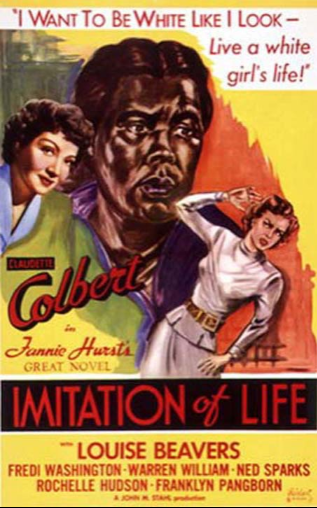
Release Date: 11/26/34 Genre: Drama Rating: N/A
Black & White Director:John M. Stahl Studio(s):Universal Pictures, Realart Pictures Inc. Running Time:111 mins.
Cast: Louise Beavers (Delilah Johnson), Fredi Washington (Peola Johnson, age 19), Claudette Colbert (Beatrice ‘Bea’ Pullman), Warren William (Steve Archer), Rochelle Hudson (Jessie Pullman, age 18), Ned Sparks (Elmer Smith), Dorothy Black (Peola Johnson, age 9), Juanita Quigley (Baby Jessie Pullman, age 3), Peola (Sebie Hendricks, age 4), Marilyn Knowlden (Jessie Pullman, age 8), Dorothy Black (Peola Johnson, Age 10).
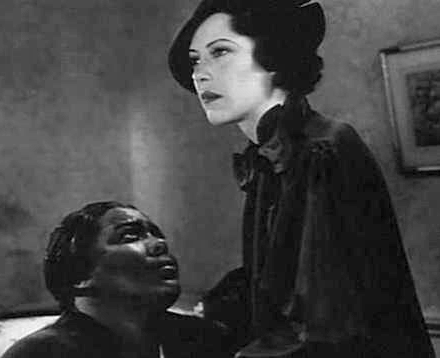
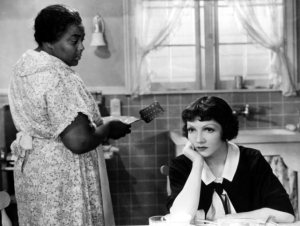
Story:White widow Bea Pullman and her two-year-old daughter Jessie are having a rough morning. Jessie doesn’t want to go to the day nursery but she must because her mother is trying to continue her husband’s business, selling heavy cans of maple syrup door to door, and making very little money. Black housekeeper Delilah Johnson is also having a bad morning. She misread an advertisement and came to the wrong house—Bea’s. Delilah explains that no one wants a housekeeper with a child, and introduces her daughter Peola, whose fair complexion hides her African American ancestry. Bea can’t begin to afford help, so Delilah offers to keep house in exchange for room and board. The four quickly become a family. They all particularly enjoy Delilah’s pancakes, made from a secret family recipe.
Bea uses her business wiles to get a storefront and living quarters on the boardwalk refurbished on credit, and they open a pancake restaurant where Delilah and Bea cook in the front window. Five years later, they are debt-free. The little girls are good friends, but one day Jessie calls Peola black. Peola runs into the apartment declaring that she is not black, won’t be black, and that it is her mother who makes her black. Cradling her weeping daughter, Delilah tells Bea that this is simply the truth, and Peola has to learn to live with it. Peola’s father, a light-skinned African American, had the same struggle, and it broke him. Delilah receives another blow when she finds out that Peola has been “passing” at school.
One day, a hungry passerby, offers Bea a two-word idea in exchange for a meal: “Box it.” Bea hires him, and they set up the hugely successful Delilah’s Pancake Flour business. Delilah refuses to sign the Incorporation papers, and when Bea tells her that she can now afford her own home, Delilah is crushed. She does not want to break up the family. So the two friends continue to live together, and Bea puts Delilah’s share in the bank.
Ten years pass. Both women are wealthy and share a mansion in New York City. Delilah becomes a mainstay of the African-American community, supporting many lodges and charitable organizations and her church. She tries to give Peola every advantage, including sending her to a fine Negro college in the South, but Peola runs away.
Meanwhile, Elmer arranges for Bea to meet a handsome ichthyologist, Stephen Archer. They hit it off immediately and plan to marry. Then eighteen-year-old Jessie comes home on college vacation, and during the five days it takes for Bea and Delilah to find Peola, she falls in love with Stephen.
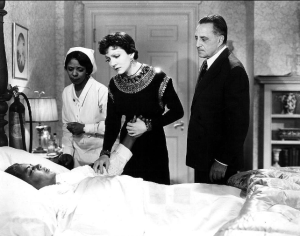
Peola has taken a job in a segregated restaurant in Virginia. When her mother and Bea find her, she denies Delilah. Delilah can give her everything that money can buy, but she can’t change who she is. Peola finally tells her mother that she is going away, never to return, so she can pass as a white woman—and if they meet on the street, her mother must not speak to her. Delilah is heartbroken and takes to her bed, murmuring Peola’s name and forgiving her before eventually dying of a broken heart.
Delilah has the grand funeral she always wanted, with marching bands, a horse-drawn white silk hearse, and all the lodges processing in a slow march. The coffin is carried from the church to the hearse through the saber arch of an honor guard, and a remorseful, sobbing Peola rushes to embrace it, begging her dead mother to forgive her. Bea and Jessie gather her into their arms and take her into the car with them. Peola decides to return to college. Bea asks Stephen to wait, promising to come to him after Jessie is over her infatuation. At the end, Bea starts to tell Jessie about the day they met Delilah.
Details: The screenplay was based on Fannie Hurst’s 1933 novel of the same name. The film was originally released by Universal Pictures on November 26, 1934, and later re-issued in 1936. A 1959 remake with the same title was directed by Douglas Sirk. In 2005, Imitation of Life was selected for preservation in the United States National Film Registry, being deemed “culturally, historically, or aesthetically significant”. It was also named by Time in 2007 as one of “The 25 Most Important Films on Race”.
Universal had difficulty receiving approval from the censors at the Hays Office for the original script they submitted for Imitation of Life. The elements of miscegenation in the story, were objected to, which the Office stated, “not only violates the Production Code but is very dangerous from the standpoint both of industry and public policy.” The project was rejected as, “Hurst’s novel dealing with a partly colored girl who wants to pass as white violates the clause covering miscegenation in spirit, if not in fact!” The Production Code Administration’s (PCA) censors had difficulty “negotiating how boundaries of racial difference should be cinematically constructed to be seen, and believed, on the screen.” Their concern was the character of Peola, in whose person miscegenation was represented by a young woman considered black, but with sufficient white ancestry to pass as white and the desire to do so. Susan Courtney says that the PCA participated in “Hollywood’s ongoing desire to remake interracial desire, a historical fact, as always already having been a taboo.” They also objected to some language in the script, and a scene where a black young man is nearly lynched for approaching a white woman whom he believed had invited his attention. Ultimately the ending of the film differed from the novel. While Peola leaves the area never to return in the latter, in the former she returns, going to her mother’s funeral and showing remorse. Source(s): Wikipedia; IMDB; Themotionpictures.net; Ferdyonfilms.com.
Release Date: Original Release Date: December 27, 1991 Genre: Drama Rating: NR Running Time: 112 mins. Director: Julie Dash Studio: American Playhouse, Geechee Girls, WMG Film, Kino International
Cast: Cora Lee Day as Nana Peazant
Matriarch of the Peazant family, determined to stay on the island
Adisa Anderson as Eli Peazant
Nana’s grandson, torn between traveling north and staying on the island
Alva Rogers as Eula Peazant
Eli’s wife, who was raped by a white man and is now pregnant
Kay-Lynn Warren as Unborn Child
The spirit of Eula’s unborn child, who is Eli’s daughter, narrates much of the film
and magically appears as a young girl in some scenes before her birth
Kaycee Moore as Haagar Peazant
Nana’s strong-willed granddaughter-in-law, who is leading the migration north
Cheryl Lynn Bruce as Viola Peazant
One of Nana’s granddaughters, she has already moved to Philadelphia
and has become a fervent Christian
Tommy Hicks as Mr. Snead
A photographer from Philadelphia, engaged by Viola to document
the family’s life on the island before they leave it for the North
Bahni Turpin as Iona Peazant
Haagar’s daughter, in love with St. Julian, a Native American who will not leave the island
Cochise Anderson as St. Julien Lastchild
Barbara-O as Yellow Mary
Another of Nana’s granddaughters, she returns from the city for a final visit to the island,
along with her lover, Trula
Trula Hoosier as Trula
Yellow Mary’s young lover
Umar Abdurrahman as Bilal Muhammad
A practicing Muslim, and a pillar of the island community
Cornell Royal as “Daddy Mac” Peazan
Patriarch of the family
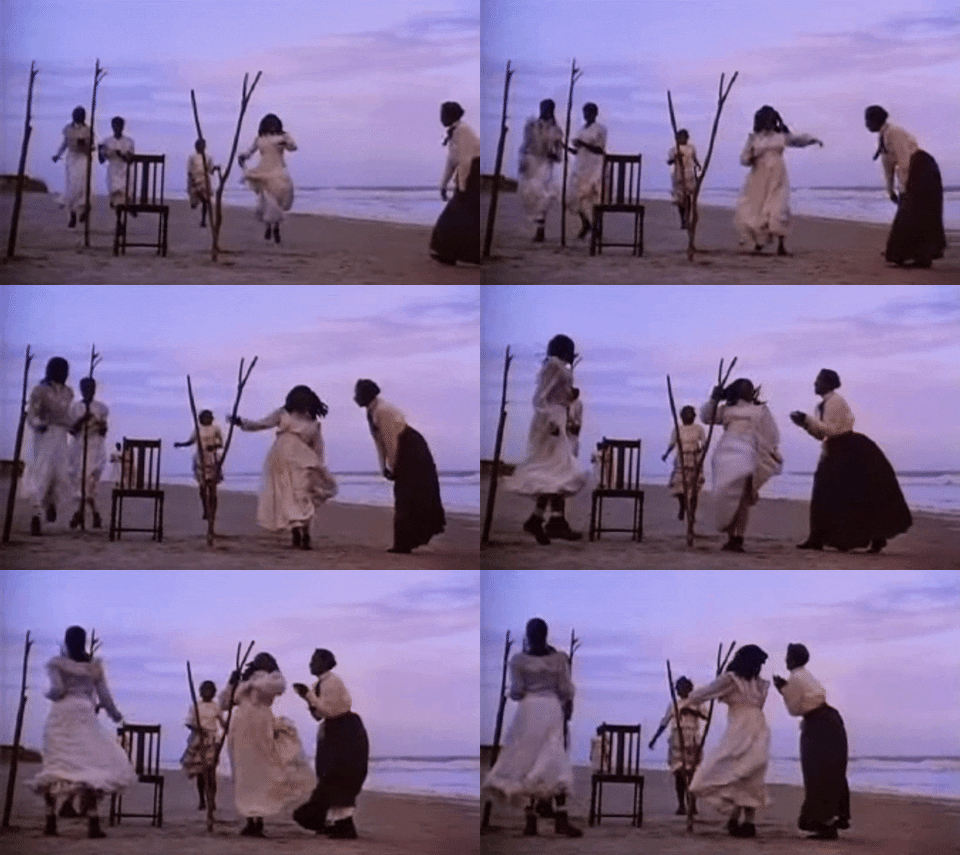
Details: First feature film directed by an African-American woman distributed theatrically in the United States. The movie is set in 1902 and tells the story of three generations of Gullah (also known as Geechee) women in the Peazant family on Saint Helena Island as they prepare to migrate to the North on the mainland. Filmed on St. Helena Island in South Carolina, Daughters of the Dust gained critical praise for its lush visuals, Gullah dialogue and non-linear storytelling. The film is known for being the first by an African American woman to gain a general theatrical release.
Story:Daughters of the Dust is set in 1902 and revolves around members of the Peazant family, Gullah islanders who live at Ibo Landing on St. Simons Island, off the Georgia coast. Their ancestors were brought there as enslaved people centuries ago and the islanders developed a language—known as Gullah or Sea Island Creole English—and a culture that was creolized from West Africans of Ibo, Yoruba, Kikongo, Mende, and Twi origin and the cultures and languages of the British Isles, with the common variety of English. Developed in their relative isolation of large plantations on the islands, the enslaved peoples’ unique culture and language have endured over time.
Narrated by the Unborn Child, the future daughter of Eli and Eula, whose voice is influenced by accounts of her ancestors, the film presents poetic visual images and circular narrative structures to represent the past, present and future for the Gullah, the majority of whom are about to embark for the mainland and a more modern way of life. The old ways are represented by community matriarch Nana Peazant, who practices African and Caribbean spiritual rituals and who says of the Unborn Child, “We are two people in one body. The last of the old and the first of the new.”
Contrasting cousins, Viola, a devout Christian, and Yellow Mary, a free spirit who has brought her lover, Trula, from the city, arrive at the island by canoe from their homes on the mainland for a last dinner with their family. Yellow Mary plans to leave for Nova Scotia after her visit. Mr. Snead, a mainland photographer, accompanies Viola and takes portraits of the islanders before they leave their way of life forever. Intertwined with these narratives is the marital rift between Eli and his wife Eula, who is about to give birth after being raped by a white man on the mainland. Eli struggles with the fact that the unborn child may not be his.
Several other family members’ stories unfold between these narratives. They include Haagar, a cousin who finds the old spiritual beliefs and provincialism of the island backwards, and is impatient to leave for a more modern society with its educational and economic opportunities. Her daughter Iona longs to be with her secret lover St. Julien Lastchild, a Native American, who will not leave the island.
While the women prepare a traditional meal for the feast at the beach, the men gather nearby in groups to talk. The children and teenagers practice religious rites and have a Bible-study session with Viola. Bilal Muhammad leads a Muslim prayer. Nana evokes the spirits of the family’s ancestors who worked on the island’s indigo plantations. Eula and Eli reveal the history and folklore of the slave uprising and mass suicide at Igbo Landing. The Peazant family members make their final decisions to leave the island for a new beginning, or stay behind and maintain their way of life. Source: Wikipedia; IMDB; listart; Giphy.com.
Release Date:1/31/74 Genre: Drama/Historical Rating:TV-PG Director: John Korty Studio(s): Tomorrow Entertainment, CBS Running Time:110 mins.
Cast:Cicely Tyson (Jane Pittman), Richard Dysart (Master Bryant), Odetta (Big Laura), Michael Murphy (Quentin Lerner), Rod Perry (Joe Pittman), Arnold Wilkerson (Jimmy), Will Hare (Albert Cluveau).
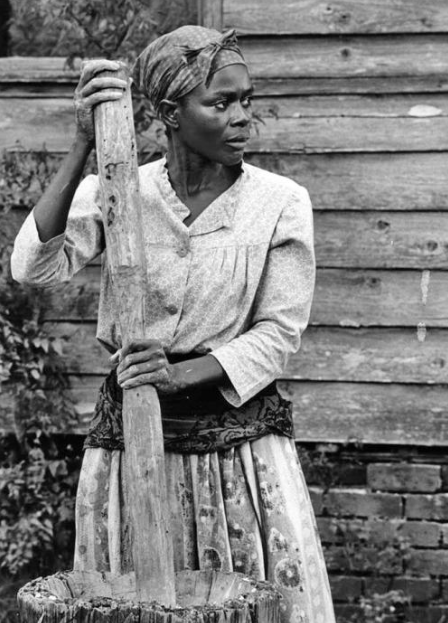
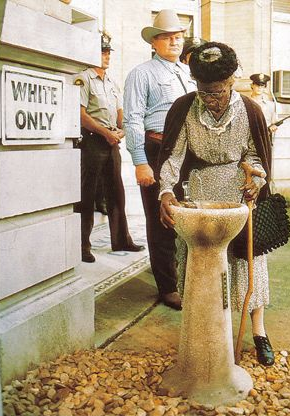
Details: The Autobiography of Miss Jane Pittman is a made for television film based on the novel of the same name by Ernest J. Gaines. The film was broadcast on CBS on January 31, 1974. In this fictionalized biography, Cicely Tyson stars as the 110-year-old Jane Pittman, who recounts the events of her life as they relate to a century of racism in America. Born into slavery in the 1860s, Jane lives through the Civil War and into the civil rights movement. Ernest J. Gaines wrote the book in 1971 and meant for it to be an archetypal “life” encompassing the black experience in America. Winner of nine Emmy Awards, including Outstanding Drama of the 1973 – 1974 season, The Autobiography of Miss Jane Pittman was one of the most acclaimed television movies of all time.
Story: Jane Pittman is celebrating her 110th birthday in 1962. She lives in the old slave quarters on a plantation outside Baton Rouge, Louisiana. When Quentin Lerner, a reporter from the East, comes to interview her, she obliges with the story of her life.
Jane recalls her experiences as a slave girl during the Civil War; her re-naming experience one year before the Emancipation Proclamation; her abortive trek to freedom in Ohio; her years working as a field hand; her brief period of happiness as the wife of Joe Pittman, a black cowboy; her sorrow over the murder of Ned, a schoolteacher who tried to establish a school for blacks in the early 1900s; and her mixed feelings about black activism in the civil rights movement.
Jane endures the misery and hardships that come her way repeatedly over the years. Her story reveals the persistence of racial prejudice, evident in the acts of murderous violence that take away loved ones and the patronizing attitudes of the whites she serves most of her life. Her autobiography is a chronicle of quiet heroism ant that is why on the day when she makes her final and conclusive stand for freedom, her act has all the emotional force and telling impact of a century of preparation. Source(s): Wikipedia; spiritualityandpractice.com; Fandor; Rotten Tomatoes; Daarac.org; IMDB; Culvercitycrossroads.com.




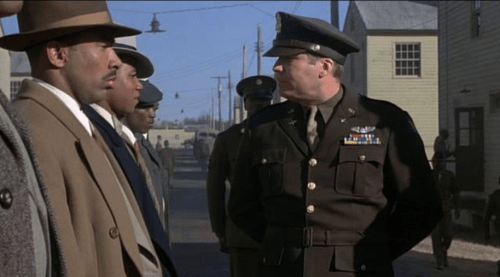 The cadets are briefed by Rogers and Joy, both with their own views that set the tone for what the cadets would later face in training: Rogers has an optimistic view, wanting the cadets to prove the naysayers wrong and letting them know how much of an honor it would be for them to pass the training and earn their wings as aviators. Major Joy, however, reflects the views of most of white America at the time, belittling the cadets and questioning whether they are up to the task.
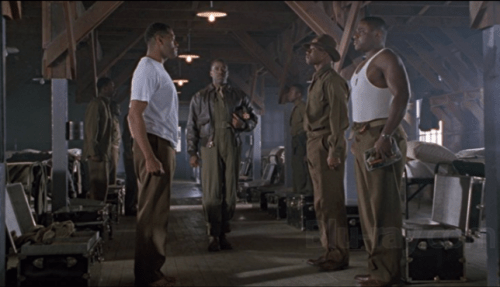 Peoples performs some unauthorized aerobatic maneuvers which catches the attention of Colonel Rogers and Major Joy, and results in him being removed from the training program. Peoples pleads with them not to put him out of the program, but to no avail. To avoid going home in disgrace, an emotionally distraught Peoples commandeers an AT-6 plan and commits suicide by deliberately crashing it.
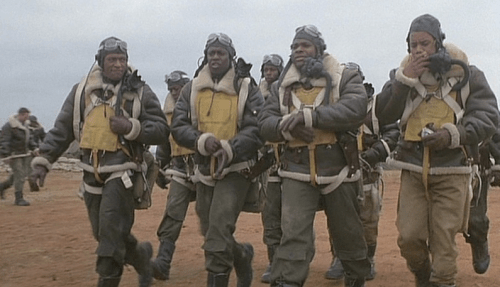 The men are eventually deployed to North Africa, as part of the 99th Pursuit Squadron, though they are relegated to ground attack missions. During the campaign, Lee’s flight encounters a group of Messerschmitt Bf 109s. Ignoring Lee’s orders, Cappy breaks formation and attacks, downing one of them. Another Bf 109 hits Cappy’s fighter aircraft numerous times and Cappy is killed when his damaged fighter plane crashes after catching fire.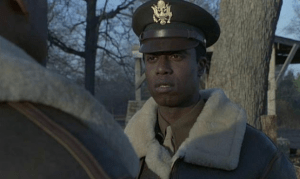

 Release Date:
  Story: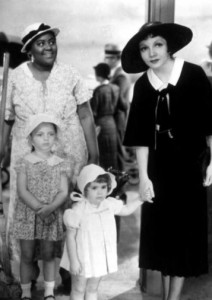
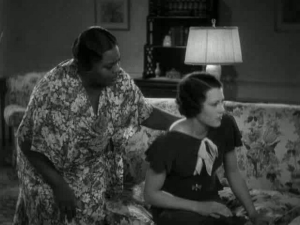 Ten years pass. Both women are wealthy and share a mansion in New York City. Delilah becomes a mainstay of the African-American community, supporting many lodges and charitable organizations and her church. She tries to give Peola every advantage, including sending her to a fine Negro college in the South, but Peola runs away.
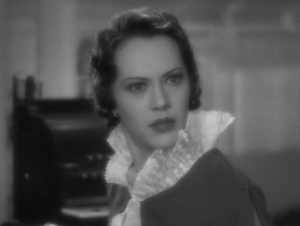 Peola has taken a job in a segregated restaurant in Virginia. When her mother and Bea find her, she denies Delilah. Delilah can give her everything that money can buy, but she can’t change who she is. Peola finally tells her mother that she is going away, never to return, so she can pass as a white woman—and if they meet on the street, her mother must not speak to her. Delilah is heartbroken and takes to her bed, murmuring Peola’s name and forgiving her before eventually dying of a broken heart.
 Delilah has the grand funeral she always wanted, with marching bands, a horse-drawn white silk hearse, and all the lodges processing in a slow march. The coffin is carried from the church to the hearse through the saber arch of an honor guard, and a remorseful, sobbing Peola rushes to embrace it, begging her dead mother to forgive her. Bea and Jessie gather her into their arms and take her into the car with them. Peola decides to return to college. Bea asks Stephen to wait, promising to come to him after Jessie is over her infatuation. At the end, Bea starts to tell Jessie about the day they met Delilah.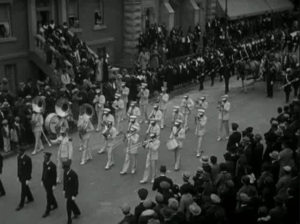






 Black Cinema Connection